Showing posts with label interview. Show all posts

10.10.2011

How Did You Do It? A Conversation with Daniel Clowes

Portions of this interview were used in a recent article I wrote about Daniel Clowes and Adrian Tomine for the SF Weekly. My thanks to Mr. Clowes for his time.
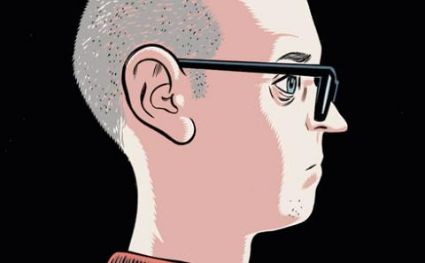
You have famously criticized art school in your work. Do you think art school was a waste of time? What did you get out of it?

It wasn’t really a waste of time. At the time I went, nobody really had any notion of teaching the kinds of things that I wanted to learn. There’s something about the rarity of a kid who really wants to learn these specific skills and has a goal-oriented plan in mind where he wants to accomplish certain things very specific, and to have people tell him that those aren’t worthy goals and that nobody is going to teach him these things -- it was frustrating and humiliating. 

I went there with this bright-eyed kid from the Midwest moving to New York quality of wanting to be in the town where all the great comic books were produced and learning the secret arts of how those were put together -- and then to be told that, really, you should just learn how to do second-rate abstract expressionist paintings, and that that was more valid than trying to tell a story in pictures, it was just really dispiriting. 

But, that experience was also very helpful, later on -- learning that I needed to figure out all of this stuff for myself, and come at it through my own experimentation. 

So they had no cartooning instruction at all at that time?

No, not at all. Nobody taught it.

What was your area of focus?

When I started, my major was drawing. I figured that would be the most helpful. And it was sort of useless. You do some figure drawing and stuff, but it was just a tiny subset of the stuff I needed to learn. I switched to graphic design, and that wasn’t quite what I wanted. And then I switched to illustration. 

It was like going to school to be a dog trainer and they teach you to raise fish or something. A lot of it just wasn’t what I needed to learn. And comics aren’t that much about art. I feel like art school isn’t necessarily the place to go. It’s closer to writing than drawing in many ways. Now they have schools that are devoted to teaching comics. And maybe that’s not such a good thing, either. Maybe it’s better to learn it on your own.

What were the immediate post-college years like for you? What paid the bills?

It seemed like an eternity, but I spent a year living with roommates and sponging off of girlfriends and stuff. I got out of school, and all my teachers said, “You’ve got this great portfolio! You’ll be getting illustration work in magazines right away!” I had enough money to spend six months in New York taking my portfolio out to magazines trying to get illustration work. It seems like it [lasted] ten years. 

Every day, I’d drop off my portfolio and wait around until the end of the day and I could tell the art director hadn’t even looked at it. It was the most frustrating thing. I never got a single illustration job. 

And just when I was ready to give up and go back to Chicago and live with my parents again, a friend of mine got a job as the editor of Cracked magazine. He just blundered his way into that job. So I wound up getting work in Cracked magazine and that saved my life. That was my first professional work. I was about 23. I’d been out of school about half a year. 

Have you made it solely off cartooning income since Cracked?

Yeah. Back then, I don’t think I made in the five digits for at least five or six years, but you could live really cheaply. I remember at the time thinking it was just a crazy amount of money we needed to come up with, but now it’s inconceivable that you could live on $7,000 a year.

How long did you stay in New York?

Not long after that. That was the first thing I had to come to grips with. “If I’m going to be doing this, I’m not going to be living here.” Not even in the wilds of Brooklyn, where I was living. But in Chicago you could get a nice apartment for $300 a month. 

I heard you say recently in response to a fan’s question at a Q&A that the way your art looks now reflects the way “I always thought comics should look.” Could you expand on that? Because it almost sounds like you’re saying that comics are a visual abstraction.

I think what I was stumbling through with that is: The way I’m trying to get my drawings to look is to where – through my eye – they have no style at all. When I was kid, it seemed to me that there were certain comic artists who were drawing without any quirks or anything that differentiated it from a standardized vision of how comics would look. So I’m trying to do that. To me, my work looks almost like it has no style, like I’m trying to just transcribe reality in the way I see it. 

When I read people talking about it, I get the idea that it has a very distinctive style. I’m always shocked when people can recognize my work – when they just see a face or something and know that I drew it. I think, “How would you know?” 

But I think that’s what a style is, it’s that little system of psychological quirks that come through in the work that the author is probably the last to see. The kind of work that I dislike or that always seems kind of cheap to me is when somebody is really trying to have a style, and tries to make everything look a certain way to fit into their quirky style. Illustrators especially do that -- I just always find that hideous.

I thought The Death Ray was maybe the darkest story you’ve written --

Maybe.

-- and it occurred to me that a lot of the characters in your stories are angry people, but it come out in different ways. And it’s often funny. But in this book, it’s almost never funny. There’s less humor. 

I find some of it funny, but in ways that I can’t imagine anyone else would ever find funny.

The protagonist becomes truly dangerous. Did you consciously shift away from humor?

When I set out to do that story, I did not think of it as something that was necessarily going to be funny. You never really know which way they’re going to go when you begin. Sometimes they become funny without you really wanting them to. 

I had the character in mind – the two versions of the character: the young, naïve, lonely kid and the bitter, angry middle-aged man. And trying to navigate how one becomes the other became the focus of the story. They become about the characters and the characters come alive and you can’t really change them at a certain point – they just become who they are – and he became a really dark, angrier-than-usual character. 

A lot of the response to The Death Ray is that it’s your reaction to superhero comics, which seems kind of simplistic.

Certainly it’s not a response to the last forty years of superhero comics [laughter]. I haven’t really read a superhero comic since I was seventeen years old. I tried to read Watchmen, and that was about it. It’s just not something I’m that interested in. 

But it certainly is a response to how I felt when I read the early Steve Ditko Spider-Man comics when I was fourteen years old – and what I hoped to get from superhero comics as a teenager, but never quite did get. This feeling of – can’t even quite describe it – but there’s a certain quality suggested by the imagery in superhero comics that I never felt was quite delivered, that seemed really charged with emotion and kind of big and dark and strong. And then when you actually read them, they’re just kind of frivolous and silly and formulaic. So I was trying to fulfill something that I had imagined could exist when I was fourteen or fifteen years old.

Right – as in Peter Parker never coming across as a real kid?

In the early ones, he kind of did. I kind of related to him. Then all of a sudden Steve Ditko stopped drawing it and Peter Parker puts on about forty pounds of muscle and he looks like the most hateful jock creep. And the whole point of the comic is he’s this 120-pound bookworm with no friends who lives with his aunt – and then all of a sudden he’s Big Man on Campus, like he’s a superhero in his secret identity as well when he’s Spider-Man. It’s just a completely different idea. I remember even as a kid being bummed out by that. 

How did you meet Adrian Tomine?

I moved to Berkeley in 1992. And he had sent me his mini-comics when I was living in Chicago, and so I knew his work. I was probably about 29 or 30, and I remember thinking that he had to be 26 and 27. He was really good, and he seemed like he might be just a few years behind me and the Hernandez brothers. I just figured he was around that age.

He had done an issue of his Optic Nerve mini-comic with his photo on the cover. At the time, my wife was studying at Berkeley, and she said, “I’m pretty sure this guy is in one of my classes.” And I said, “No, no, this guy’s like 27, 28. I’m sure it’s just a bad photo.” She’s like, “No, I’m sure I’ve seen this guy.” Next day, she says, “Oh I talked to that guy. That’s him – Adrian.” And it turned out he was the youngest guy in the class – he was only 18 or 19.
And then it turned out he lived a block away from me, which was quite an odd coincidence – that somebody that talented would wind up on the same block as me. We wound up getting together for coffee and becoming friends. Instead of having friends his own age, he used to hang out with me and all the older cartoonists – a bad influence on him.

How would you say you’ve influenced one another’s work?

He’s certainly influenced me just by the way he is so adamantly into telling these stories, and he doesn’t try to do any crazy gimmicks in his illustration. He’s just focused on telling the story in the best way possible. That’s always been very inspiring, for me to see that – to see a kid who is really trying to hone his narrative skills as opposed to just showing off with his drawing, which is certainly what I was interested in when I was 18 or 19 – just doing cool drawings in my comics. And he seemed completely uninterested in dazzling anybody with his artwork. He just wanted to affect people emotionally, and that was something to follow.

And I love that he sticks to drawing about Berkeley a lot, when he was living in Berkeley. I could recognize almost every location in those comics – the Chinese restaurant that used to be on College Avenue. It’s great to have that record of it. He had a small orbit in his world, and he really focused on it and tried to make it something universal.

Is that something you’ve tried to do as well? I certainly noticed that the locations in Wilson and Mr. Wonderful look like the East Bay.

Wilson’s certainly all Oakland, as is Mr. Wonderful. They’re in that orbit. I like the idea of imagining some random guy that I’d see every day on my dog walk – having him come to life. That’s where those two came from.

Have you seen Optic Nerve #12 yet?

I just got it.

There’s a really funny postscript he did about his struggle to continue doing the comic.

Yeah – I liked that!

You’re quoted in there, from some NPR interview. Do you think there’s any value any putting out your own anthology comic anymore?

There’s plenty of value. It’s just the marketplace seems so hostile to it. When I was coming to grips with – when I was doing Wilson, I was thinking, “Do I do this as a comic? Do I do it as a book?” It seemed like an act of defiance to do it as a comic, and it seemed to be so freighted with some kind of meaning that I didn’t intend for the book to have. I didn’t want it to be about the format or about the marketplace. I want the work to be what people are focusing on, so I want it to be in a format that feels the most natural to the readership. And I felt like that had shifted from periodical comics to graphic novels.

I love reading comics like Adrian’s, although I have to say when I read it, I felt this feeling of pain at the end, like, “This took me 20 minutes to read, and it could be two years before I read another one.” 

When everybody used to do comics, you knew that next month, Chester Brown would do a comic, and after that, Peter Bagge would do a comic. There was always going to be something to read. But I can’t think of the last comic before this that I bought or read. When there’s one every year or two years, it’s a very different thing, and something kind of painful about it!

I always think that when I’m done reading – even something book-length, “God, I just read that in an hour.”

And I know Adrian worked thousands of hours on that comic. And you can’t ever do the math in that way. I always think the cumulative hours spent by all the people who read it has to exceed the amount of time you spent on it. [Laughter]

Comics seems like a great medium for a perfectionist. And screenwriting seems like it’s completely the opposite.

In terms of the final product, that’s absolutely true. But if you just think of the screenplay as the finished work, which is the only way I know how to do it, you actually have even more control over the screenplay than you do over a comic. Because once a comic starts going in a weird direction that you might want to correct, you’re not going to re-draw forty pages and make things work out. Comics are very organic. They go in their own way and you’re stuck with the final result. You could spend a lifetime re-drawing things over and over to get it right. 

But in a screenplay, you can cut out 40 pages in the middle and put something else in. You can change characters’ names and descriptions. So there’s a certain fluidity to it that, to me, is really refreshing. But I have to then cut off all expectations the minute I’ve sent the script off to somebody. 

But if someone writes a play, somebody could do a hideous production of that play, but that doesn’t affect the play. So I sort of think of it in those terms, even though nobody really reads a screenplay as a play – and it’s a very different thing than a play. 

When you’re working in comics, how tightly do you script before you start working on the art?

My goal is always to script very tightly and plan everything out in advance. But then I find you dissipate all your energy. A big part of comics is maintaining your energy and your focus and your enthusiasm. You have to be able to get up every Monday morning and say, “Okay, I’m ready to get back to page 63 of this comic,” with the same level of interest that page 1 had. 

To do that, I find that I have to be a lot more spontaneous and keep the thrill of possible catastrophic error alive the whole time. Which means I do have to re-draw things every now and then, or finesse my way around things. But after you do it for long enough, you can figure out how to make things work or minimize your anguish around mistakes.

Fantagraphics is putting out a collection of Nancy strips, many of which came from your own collection.

I found it baffling that I had the best collection of Nancy strips. I bought a bunch of them off eBay in like 1998. It didn’t take any special effort. I just found some dealer that had a whole bunch of them, and I bought all of them I could get my hands on. And when it came time to do the book, they were looking all over and they couldn’t find them anywhere. And I had almost all of them.

What form did you buy them in?

It was some crazy collector who cut them out of the paper and wrapped them in Saran Wrap in little blocks, so I have blocks of every year. And I’m missing a few, but I have pretty much everything from 1943 through 1969 or something like that.

How would you characterize yourself as a comics collector? Do you have particular areas of interest?

I’m not one of those completists who’s got to have everything by everybody. In this case, I just really wanted to read these Nancy strips. I was trying to find stuff I couldn’t get otherwise. If I’d known they were going to do these collections now, I would have just been happy to just wait for them. But for years, the only way you could read a lot of these old comics was to just get the original tear sheets. So I have stacks and stacks of old Sunday pages and things like that.

6.30.2011

How Did You Do It? A Conversation with Rob Corddry

Rob Corddry’s newest series, Adult Swim’s Childrens Hospital (that’s right: no apostrophe), is a gag-a-second mockery of one of television’s old standbys: the medical drama. Childrens Hospital is the next logical step for Corddry, who began as an actor in college, continued into improv with the Upright Citizens Brigade, and landed a spot on The Daily Show in 2002. Since then, he’s made some memorable appearances in movies, including Hot Tub Time Machine, and a role as presidential press secretary Ari Fleischer in Oliver Stone’s W.

On Thursday, June 30th, SF Sketchfest will present the cast of Childrens Hospital live on stage, along with the cast of the forthcoming series National Terrorism Strike Force: San Diego: Sport Utility Vehicle [NTSF: SD: SUV] – a parody of police procedurals and action programs in the vein of 24. That show, which premieres next month on Adult Swim, was created by Paul Scheer, formerly a partner of Corddry’s at Upright Citizens Brigade, and co-stars Rob Riggle, who worked with Corddry both at UCB and The Daily Show.

I started my recent conversation with Corddry by asking him about the earliest part of his career.

What was your training prior to joining the Upright Citizens Brigade?

I was a theater and English major in college, and literally the day after graduation, I moved to New York City. I hit the pavement pretty hard and was set on becoming the highest-paid crappy Shakespearean actor ever. I would get Backstage magazine and audition for absolutely everything. And one of the things I got was a play where I met this woman who was in a sketch group. So I auditioned for the sketch group, and I got it. And I was like, “Do I really want to do this? I’m a very important Shakespearean actor.” But six months later, I was furiously writing sketches and learning how to do comedy. We were terrible. It was the worst sketch group in New York’s history. Then I started a sketch group with a bunch of friends called Naked Babies, which exists today – but then, we found UCB.

What years were you at the UCB in New York?

I was actively doing shows every night from about ’97 to about 2001, 2002. When I got on The Daily Show, I just didn’t have the time. And from then on, I’ve just performed sporadically. But for a few years, it was five to seven shows a week. Paul Scheer [Childrens Hospital guest star and creator of NTSF: SD: SUV] and Rob Huebel [co-star of Childrens Hospital] and Rob Riggle [fellow alum of The Daily Show and co-star of NTSF: SD: SUV] were in the class ahead of me.

Were you aware at the time that The Daily Show was going to be a leap forward for you? Looking back on it now, how do you think that experience affected your approach to comedy in general?

I was certainly aware of how special it was. It definitely seemed like a “right time, right place” scenario. We knew it was lightning in a bottle. I wasn’t really thinking about how much it was going to help my career – any more than I always do. [Laughs] My career has been a very long, slow, gradual turtle-walk up a long flight of stairs. But that’s good because that means there’s always an easy learning curve. But The Daily Show did teach me how to be funny on TV – which is how it informed my present work.

Has anyone in the press ever tried to pull a Daily Show-style interview on you?

There was one kid – I was in Austin for something, and somebody interviewed me on the street. Some college kids. And they kept hitting me in the mouth with the microphone. I was like, “Really? You’re pulling a Mo Rocca, circa the year 2000 on me?”

Given that you and most of the cast of Childrens Hospital have a background in improv, I wondered if improvisation played any part in the development of the show.

The development process was very deliberate. But there is improv happening once we feel like we’ve got what we need in the script. Of course, it would be a shame to waste the talents of these brilliant improvisers – I mean, Rob Huebel is probably one of the best improvisers alive. So, I can definitely point to a couple of lines in each episode that are improvised. But for the most part, it’s a tightly-scripted show. And we all have our strengths. Jon Stern, who will be at the show in San Francisco, is one of those rare producers who can write a great joke and can also book a caterer. David has way more experience with that than I do, too. I’m just the monkey in the corner spouting jokes and clanging cymbals.

Are you still the primary writer? You’re credited with many of the scripts.

I like to write about half of them. And I enjoy doing it. It’s really fun to write this show. But also, the three of us edit every script that comes in written by someone else – just to control the voice of the show.

I understand that when you brought the show from the web series to Adult Swim, you preferred the 15-minute format offered by Adult Swim as opposed to the standard 30-minute format of most comedy shows.

Absolutely. I had no interest in bringing it to television at all, until I heard that there was such a thing as a 15-minute format. I just don’t think this relentless joke-after-joke kind of show would be interesting after 15 minutes. This is joke-based comedy, as opposed to character- or relationship-based comedy.

The spinoff [NTSF: SD: SUV] begins airing next month?

As much as I’d like to take credit, it’s not a spinoff and I had nothing to do with it. Jon Stern is the connection – he’s executive producing it with my good friend Paul Scheer. And we come from the same family of comedy – I’d say it’s the same genre. But there’s no real connection to Childrens.

But it [NTSF: SD: SUV] began as a phony advertisement during the re-broadcast of the initial web version of Childrens Hospital on Adult Swim.

That’s right. Paul was nice enough to bail me out, in a way, because I was about 45 seconds to a minute short for one episode. They had shot that fake commercial as sort of a pilot, so Jon suggested sticking that in there. I said, “Great! As long as there’s a lot of punching.”

Will the San Francisco show mark the first time the Childrens Hospital cast has performed live together?
 
Last season we did some screenings, where we did some live bits – some successful, some not. We’ve learned our lesson and we’ve planned this show out a little bit more. We’re each going to show an episode that hasn’t been seen yet, and we’ll do a Q&A together. And we’ll do some bits. Actually, we’re slowly plotting a live Childrens Hospital tour. We wanted to get it out this fall, but that’s not going to happen. So ideally, we’d like to do it in the spring, before colleges let out. It’s a beast to put together, and none of us have a lot of time. This would be a tightly-scripted show. There would be live music – actually, I believe it’s going to be a musical.

This article is an expanded version of a piece that originally ran on the SF Weekly's arts blog, Exhibitionist. The original version is available here.

5.03.2011

How Did You Do It? A Conversation with Maria Bamford

Maria Bamford is known for her highly distinctive, painfully funny, and uncompromisingly personal stand-up comedy. Though often cited for her mimicry of family members and various regional “types,” Bamford’s “voices” are anything but a gimmick. She uses her vocal skills to satirize common experience and social maladies in ways that are impossible to compare with any other comic. (To wit: her well-known bit in which she adopts the persona of a certain type of female comic who will, in exchange for shoes and chocolate, allow her date to “go through the back door.” Bamford’s characterization is flat-out funny, but the joke itself challenges audiences to ask themselves what they find funny and why.)

Bamford has raised her profile significantly over the last half-decade. Her recent live album, “Unwanted Thoughts Syndrome,” appeared on a slew of top ten lists. Constantly touring far and wide, she remains furiously active in the L.A. comedy scene, starred in her own web series (“The Maria Bamford Show”), and made multiple guest appearances on “Tim and Eric Awesome Show Great Job!” and its spin-off, “Check it Out! with Steve Brule.” All of which is to say nothing about her robust career as a voice actor, which has included regular featured work on “Sit Down Shut Up,” “Kick Buttowski,” “Adventure Time,” and “Ugly Americans.” In 2009 and 2010, an even wider audience saw her in a series of well-received television commercials for Target, in which she played a tightly-wound suburban holiday shopper.

In her stand-up act, Bamford describes her voice as “high and child-like,” but over the phone, the main thing that comes across is that she is – as advertised on her website – a “nice lady.” She’s so immediately personable that I instinctively want to refer to her by her first name instead of the more journalistic “Bamford.” She speaks of her youth and early career as a performer with direct, eye-opening frankness. Far from being a self-mythologizer, she is an incredibly productive, forward-thinking artist who is not content to rest on her laurels.
 
So, how did she do it? In discussing her career and life, Bamford is matter-of-face about her history with depression and the role it continues to play in her life, as well as the paramount importance of the creative moment (easily beating out public reception and prestige). I started our conversation by asking Maria to give me a picture of herself as a kid – how she expressed herself and what early creative activities she was exposed to:
 
MB: My dad always brought home stacks of blank paper because I liked to draw and make stuff. My dad was always very supportive: “Oh, what are you doing?”*  And I went to a lot of gifted children’s arts programs in the summer that were given by the public school. You’d do a play or something. And my parents put me in a Suzuki violin program when I was three. Now that I look back, of course, I realize how lucky I was to get a lot of support to be creative. But there was also a production aspect to it. My family are very much “producers,” so they like to ask you what you’ve been doing and you’ve got to show what you’ve been working on. I’m real grateful for all those things. I didn’t realize that those things were sort of luxuries.
 
CB: So you’re at a very young age here. All of this stuff was being set up for you by your parents.
 
MB: For music camp, for sure. The weird thing about it is I did not enjoy it that much, but I was a pretty obedient kid – it’s hard not to be obedient when you’re three – and later the peer pressure kicks in. It’s so funny because I didn’t see the violin stuff as very artistic. It was very prestige-oriented or about accomplishing something. I don’t remember enjoying it and losing myself in the music – that type of thing.
 
CB: How long did the violin lessons go on?
 
MB: Ohhh, till I was 21! I quit for the last year of high school, and then guiltily tried to re-up myself over and over again over the years, and then finally about ten years ago... I let it go.
 
CB: When did you start doing your own thing – whether it was an interest in acting or comedy? When did that start to kick in?
 
MB: I think in high school and junior high. I liked to run for office. I liked the idea of doing a speech, or plays. And that was very self-motivated – like, nobody really cared that I was doing that, and I think that was a good thing. That was really great. I went to a very tiny school, which was good for me too, because I wonder if I would have fallen through some sort of crack. You look back and you think “Thank God…” Or thank somebody. Maybe I should thank my parents. Thanks, Mom and Dad!
 
CB: So, did you know in high school that you wanted to be a performer? Or did that come later?
 
MB: No, I didn’t know that. I did acting in high school, and it was fun and exciting, but it wasn’t something I thought about. If someone said, “You can be an actress,” I would have been, like, “Uh… I don’t… ummm… huh?” I was terrified, in high school, of what was supposed happen next.
 
CB: You mean of post-high school life?
 
MB: Oh yeah. I was absolutely terrified. I remember going to college and feeling like, “What am I doing?”
 
CB: I read that you attended three colleges. Where did you end up graduating?
 
MB: From the University of Minnesota. I went to Bates College for two years. It was small, and I got to participate in a lot of things. Then I went on a junior year abroad to the University of Edinburgh. I transferred out of Bates because I was having real problems with depression, and an eating disorderrrr. I ended up going through an outpatient treatment program at the University of Minnesota while finishing my degree there, which was awesome possum.

CB: What did you end up getting your degree in?
 
MB: Creative writing. It was kind of murky. I remember going, “Uh… If I do this, can I get a degree?” Like, “If I write this thinly-veiled autobiographical play, would that count as something?” And they were like, “Sure!” I don’t remember being super-organized or focused about it. It was more like: get ‘er done.
 
CB: If you were frightened of post-high school life, what about post-college?
 
MB: It’s hard to say. I’ve had depression throughout my life. From the age of ten, I really started having some issues with enjoyment in life. So it’s hard to say what ups and downs are really caused by. But I did a lot of shows in Minneapolis and felt very goal-oriented and motivated to do things creatively. And just as I was stopping feeling motivated, I auditioned for this thing to go out to California and be a “Star Trek” character tour guide.
 
CB: Had you developed more interest in performing while you were still in college?
 
MB: I just wanted to finish my degree... I started to get more focused on what exactly I wanted to do and having some specific vision when I was kind of depressed and I was talking to this mentor-comedian Frank Conniff. He’s in Los Angeles, but was living in Minneapolis at the time. (And I think that’s important: to have mentors. You know, people who are ahead.) He said to read this very hippy skippy dippy book called “The Artist’s Way,” and I totally grabbed onto that. That book changed my life. Sometimes people will hand me a book and say, “This book changed my life,” and I’ll be like, “Really? Oh, that’s weird.” But it totally helped me focus and gave me this courage to believe in myself. I think I was 22 or 23 when I got my hands on that delightful thing and it provided me with the idea that it’s okay for me to say I’m a comedian, even if no one else thinks I am. Everyone else can be on the fence – but at least I’m on board.
 
CB: So you moved out to LA to take the “Star Trek” tour guide job.
 
MB: Yeah – which was very uncertain. It didn’t go on for that long. And I really didn’t have life skills – how to pay bills, how to hold down a job. I had always lived in these hippy cooperatives, and even then didn’t do very well. Like, I didn’t pay rent for a year once! And the rent was only $140 a month. And the hippy cooperative leader (or the guy who had been there the longest), he was like, “Hey, man, listen, uh… You gotta, kinda… C’mon!” And I was like, “God! You’re so uptight!” I think in smaller cities and artistic communities you can kind of keep scraping along and do okay – especially in Minneapolis, where there are more social services. And being young, maybe it was okay to be poor. But then I moved to Los Angeles, and not only was it super isolating, but it’s sort of terrifying to not have any money here, or family. So I went through a couple of hard years, realizing I needed some help. There was a hippy cooperative I could have moved into when I came out here, but part of me had that, “Come on! Bootstraps!” thing. And I think part of it was like The American Success Story: I Can Do It on My Own! And I think that’s kind of mythological, because you can grow more isolated that way.
 
CB: So you’re in LA, and you had the tour guide job, and maybe things weren’t going great for a couple of years. What marked a turning point? Was it a particular job? Or a change in your approach? 

MB: I got a ton of outside help. Support groups. 12-step groups. I have gotten and continue to get help there. I know not everybody’s into them, and I’m not into them half the time. But they’re free and it’s a bunch of people who have been in the same situation or are in the same situation.
 
CB: Like free group therapy?
 
MB: Some of it’s not therapy. It’s what you get from any community. Like, “Oh, you haven’t taken care of getting your teeth cleaned in three years? Let’s call each other and see if we can get that done.” I read an article in “The Week” that made me feel good because sometimes it feels like these groups can be cultish. But the article said that there was scientific study that this works – that any group helps people. Mental health-wise, people benefit from being a member of a group. So, I got a lot of help with how to have a job, how to keep showing up for a job… And you can get that through programs with the government and stuff, but I found it through these 12-step groups. Super, super helpful.
 
CB: What kind of jobs did you have while you were trying to build up a career as a comic?
 
MB: I always worked food service jobs, which was interesting, because I’d had an eating disorder, so that was sort of a poor job choice. But I did not have the confidence to say, “Hey Maria, you can type 70 words per minute and you have a degree. Why wouldn’t you try to get any job that would pay better than $6.00 an hour loading trucks at night?” That’s where I needed some sort of community to help me say, “Hey, you can do this.” For some reason, I didn’t even think I could answer the phones places, which sounds cuckooberry, but I was really scared that people knew how to do things and I didn’t. I had very remedial life skills.
 
CB: Those confidence problems must have impacted your pursuit of a show business career.
 
MB: My parents cut me off, which is probably one of the greatest things they’ve ever done. Because then I had the opportunity to say, “Oh, I can do this. I can earn enough money and take care of myself.” And I can’t imagine that that didn’t help me creatively to feel like I could take care of myself.
 
CB: Plus it frees your brain energy, right? Once you know you can handle practical stuff.
 
MB: Yeah. But with mental illness, it doesn’t matter if you have money or prestige. It’s devastating no matter what. People have killed themselves at the top of their careers, with loved ones all around. I don’t know if achievements always make a difference in people’s self-esteem or state of mind.
 
CB: One of your first credits was writing for “The Martin Short Show.”
 
MB: Yes.
 
CB: Had you written for anyone else prior to that?
 
MB: No. I think I just got that job because of some weird buzz. I was a young lady and they thought I was funny. It was like some mystical thing. Frankly, it wasn’t a great experience for me because I wasn’t very good at interpersonal relationships and group dynamics, interestingly enough.

CB: That “room full of writers” thing?
 
MB: Yeah. Because it’s working with others and I didn’t always do that very well. So I got fired. But I did give it my 100% shot!
 
CB: What did you want to follow first and foremost? Was it acting or writing or stand-up? Or all of them?
 
MB: I kept being driven to do stand-up in the way I was doing it, which was more of a “one person show” or performance art kind of thing. It didn’t always go super well in comedy clubs – and still doesn’t! Unless people know what they’re coming to see, I don’t always do well in front of a crowd of people who are just there to see “comedy.” I just wanted to do what I was enjoying, and I’m not sure I even had a name for it.
 
CB: Right, which is what this interview series is about: people who are doing something they are compelled to do even though there might not be a name for it. And how you can make it work.
 
MB: You just do it and do it and do it. And maybe somebody takes notice. And maybe they don’t. But at least you’re doing it. And that’s the victory. Because the most important thing is this moment. If I’m not creating something today – that act of creativity and the joy from that is the one thing that stays steady. That’s the only reason for doing it. Prestige, and looking back on what you’ve done isn’t really that satisfying. I’m excited about my jokes now. I don’t really care about stuff I’ve already done. I want to say, “What about this joke? Have you heard this one?” Because you always have the freedom to create things – whether or not people are interested!
 
CB: Do you set aside a time to develop new material, or is that something you’re constantly doing?
 
MB: I try to force myself to do it. Sometimes it’s hard to get myself to do it. As I’m talking to you right now, I’m thinking, “Oh God. I should go write something down…” I don’t know if it’s a workaholic thing. I always thought I would feel rested, like, “Okay, I did that. Now I can coast.” I never feel that, or I feel that for maybe a minute. Did you watch that Joan Rivers documentary? It’s just her rushing around going, “Okay, where’s my next gig? What’s the next thing?” That’s where the joy and excitement is – it’s in the thing you’re doing now. She’s this icon and I’ve looked up to her forever, and she’s like, “I’m busy. I’ve got to do this now. See you later!”
 
CB: Are there specific things you would still like to do that you haven’t gotten to yet?
 
MB: Yes! I made a pilot, and I’m gonna try to sell it. And I’m always excited about a new thing. I have an idea for a live show I want to do weekly, but I can’t talk about it because then I might not do it. And there are always new jokes, new dreams, new visions. And as far as success and affirmation: If you have a critical mind, those things don’t make a difference in the end. My brain has made it a magical trick for me where instead of using my success as a feeling of, “Oh, you’re great at what you do!” my brain makes it into pressure – added pressure. “You’ve got to keep producing.” So, uh, just enjoy the day, is what I’m trying say. (Laughs) It doesn’t get better up ahead, just different.
 
* Italics indicate where Bamford switched over to one of her many alternate voices; often enough, she uses a different voice even when impersonating herself.

5.02.2011

How Did You Do It? A Conversation with Tom Shadyac

Tom Shadyac is known for directing blockbuster comedies featuring some of the biggest names in show business. From his (and Jim Carrey’s) breakout movie, 1994’s low-budget “Ace Ventura: Pet Detective,” Shadyac went on to direct a string of enormous hits including “Liar, Liar” and “Bruce Almighty” with Carrey, and the remake of “The Nutty Professor” starring Eddie Murphy. Shadyac's most recent feature was “Evan Almighty” starring Steve Carell, the most expensive comedy ever made.

But in the fall of 2007, Shadyac suffered injuries in a bicycling accident including a concussion and a broken arm. The after-effects lingered for many months, rendering Shadyac virtually inert with intense headaches and an extreme sensitivity to light and sound. In his new documentary “I Am,” Shadyac recalls being resigned to death during his agonizing convalescence.

Yet he recovered, at length, with a renewed desire to investigate the world's ills - and his own. Shadyac's discoveries - all of which are documented in “I Am” via interviews with leading scientists, philosophers, poets, members of the clergy, and historians - resulted in personal transformation. Not only did he have his health back, he also sold his palatial Pasadena estate, gave away much of his own wealth, and adopted a minimal lifestyle. He also became committed to beginning and sustaining an ongoing public dialogue around the two main questions asked in “I Am”: What’s wrong with the world? What can we do about it?

“I Am” represents a major change for Shadyac, not just in terms of subject matter, but in terms of the way he perceives the world, himself, and his life’s purpose. I spoke to him recently in San Francisco. After a short exchange about the reading material he had with him (Rumi and Emerson), I began by asking him about his early days.

CB: How long did it take you to get to Hollywood and a show business career in the first place? Let’s say, starting after college – what were the steps you took?

TS: I got to show business fairly quickly. During my fifth year at the University of Virginia (I had to go back for one last class), I started writing jokes for Bob Hope. He responded, and I started working for him. So I got to show business fairly early. But, for eleven years, I was adrift. I wasn’t fulfilled by joke writing – it didn’t seem like “it” for me. I tried a little bit of everything, experimentally: stand-up comedy, acting, I taught acting, I wrote sitcoms, I wrote screenplays. Eventually, I went back to school to direct at UCLA’s grad school. And that’s when heavens parted. But what I had to grow into was a freer, less fear-based self. My personal journey was about learning to stand with my own authentic creative self, regardless of what the energy in a room was. Often times, I felt a fear that I would be rejected for expressing myself. So, I was living under someone else’s vision, and not my own. When I finally threw all that out, after years of therapy, I was no longer seeking approval but simply authenticity. And then, it was about a New York minute before I got my first big break, which was “Ace Ventura.”

CB: And how long after the grad program was this?
 
TS: About two or three years. I went to grad school in ’88 or ’89, and I got “Ace” in ’91 or ’92. But I had done a lot of preparation to be ready when that opportunity presented itself.
 
CB: And the grad program helped confirm that you wanted to zero in on directing?

TS: Yeah. It was that “knowing” – like Spielberg might have had when he was 8. I had it when I was 28. But then it was another several years before that knowing was realized in terms of employment. I did a lot of observing of sitcom directors. I would go anywhere I could potentially learn something. I would sit in rooms like this and hear them talk about story problems. And I would have what I thought was a wonderful idea or fix. But I wasn’t able to express myself because it wasn’t my time. But then, because I had much more fearlessness – having moved through whatever fear I had – that’s how I got “Ace Ventura.” I told them very strongly what the script needed. I came up with very specific ideas. I still remember the meeting I had with the Morgan Creek people: I handed them ten pages of a rewrite, and they said, “We’ve been in business twenty years and we’ve never had anybody do work for free. It’s our first meeting and you’re handing us ten pages.” All the work before that was preparation for being tossed into the flames.

CB: So the script had already been in development for some period of time?
 
TS: Years.
 
CB: With others, before Jim Carrey?
 
TS: Jim was perceived as a stretch as a choice – other directors had considered him, but many people simply thought of him as a television star, even though he’d done several movies before. I eventually said, “This is who I really believe in – if we can get him, it’ll be a blazing, blinding light.” Jim had to actually audition for Morgan Creek. And I remember he acted out part of the movie in a Hamburger Hamlet up on Sunset Boulevard, to convince people that not only was he the guy, but that this could really be something.
 
CB: Hard to imagine him being asked to audition now.
 
TS: Yeah – hindsight! I called some very good friends who were writers and very creative, and I said, “I’m thinking of hiring Jim Carrey.” And everybody knew him from “In Living Color.” And I often got, “He’s a TV star. He’s not a film guy.” I had to listen to my own intuition, which was, “No, I think if we tap into this guy, he could be amazing.”

CB: Now, when did the injury happen?

TS: September of 2007.
 
CB: And “Evan Almighty” had been released?
 
TS: Yes, “Evan Almighty” came out in June that summer. I hurt myself in September.
 
CB: Making strong, principled, philosophical statements like “I Am” doesn’t seem to happen often in Hollywood. How has your relationship with the industry changed – if at all – since this all took place?
 
TS: Lots of people haven’t seen it. But the few who have, have been very supportive. My agency, which may run on the current economic system that I have questions about, have been incredibly supportive. Artists who have seen the film – The Black-Eyed Peas, Peter Gabriel – gave us songs at incredible discount rates. Artists are good people, with big hearts. They’re on a journey just like I’m on a journey. They’ve been raised in a culture just like I was raised in a culture. And, I do think that films do speak about moral issues, whether they’re aware of it or not. Although this is a very direct examination.
 
CB: Yes, this is a very direct statement, with a very particular way of looking at things and asking particular questions.
 
TS: And it’s not just show business; our culture doesn’t encourage this kind of conversation. We tend to look at things symptomatically. I was just reading a Rumi poem that says, “You don’t want to hear, yet, about the reality that’s underneath, whether you call it God or life or the divine spark.” Basically, he’s saying, “So turn the news on, ‘cause that’s what you want to hear.” And that’s sort of what we encourage. I wanted the freedom to express what I had been feeling and seeing and intuiting for years and years and years, and that accident is what compelled me to do it. I had to face my own death to get over the fear that kept me from doing it before.
 
CB: Going back to the idea of “So turn the news on” – what is it about bad news? There are a lot of documentaries out there about –
 
TS: Bad news.
 
CB: – social and cultural ills, whether it’s war or the economy or whatever. But they’re always about the badness of those things and revealing what the badness is, as opposed to being constructive or offering alternatives or just asking questions as your film does. Why do you think that is?
 
TS: I think we’re young. And this vision that we have of the world is not that old. The human species has been around for 175,000 years, and this particular vision – call it the “Consumer Vision” or the “Me First Vision” – is only about 10,000 years old. And that’s really young, especially when you look at the history of life on this planet, which is 4 billion years old. I think there’s a place for, as you said, the identification of the bad. But I think we’re hungry for something new. We know the bad. We know something’s happening with the environment. We know that war after war is happening. We know that greed has surfaced in many forms. But I think it’s the challenge of each of us to heal the internal greed that we have, which is what our movie talks about. So I think it’s easier to say that the greed exists on the outside. That’s one step. But the step that we need is the one that says, “Before I heal the greed on the outside, I need to deal with my own greed, my own internal violence, my own internal anger. And emanate that.” Listen, I know these films are valuable, but I got very depressed and frustrated with this style that’s 85 minutes of the problem and two minutes of, “You can go to this website,” or whatever.
 
CB: How much of what ended up in “I Am” was a discovery for you in the process of making the movie?
 
TS: Much of it. The connective idea of unity and interconnection – I was well aware of that and felt strongly about it as a truth. But all the flesh, all the muscle on that skeletal structure was new to me. Like Heartmath. I had no idea that there was science now – fringe science, but still science – that was emerging to tell us that intuition may actually be measurable. That the heart may be the source of that intuition. That it may be able to predict the future. That the heart has an electromagnetic field that extends ten to fifteen feet from the body. Elizabeth Satoris is an evolutionary biologist who told me about the history of cells. And Rupert Sheldrake – his work wasn’t in the movie – his ideas, like, “When does your dog know when you’re coming home?” It’s when you make the decision to go home that the dog moves to the door. So all that stuff, all that evidence, that confirmed the intuition and the kind of philosophical, spiritual, and moral principles that I had been awake to through Emerson and others – that was what was really fun on the journey. To be able to say, “Wow, there’s all this cool work being done to confirm this.”
 
CB: Did you have personal connections to the people you talked to? How did you wind up coming to everyone you interviewed?
 
TS: The journey started with people I wanted to speak to who had moved me in some way. So I had read their work, or seen them in a documentary, or heard them speak. So that would be Coleman Barks, Howard Zinn, Noam Chomsky. And then often one thing led to another. We were turned on to certain people by some of the interviewees. And Harold [Mintz, Shadyac’s friend and the film’s publicist] turned me on to Mark Ian Barasch. There are many people I wanted to interview that we didn’t get to. I tried to talk to the Dalai Lama. Mary Oliver is a friend; she’s the best-selling poet in America. She was my first request, and she politely said, “My poetry speaks for itself. My poetry articulates what I believe.”
 
CB: How long did you shoot?
 
TS: We shot for two years, and there was a good solid year and a half in the editing room. Documentaries – you gotta write in the editing room, so it’s a long time.
 
CB: As far as the changes you’ve made in your own life since completing the film – selling your property, changing your whole lifestyle – how do view your pre-2007 self? When you look back at your career and your success, how do you view it now?

TS: The bike accident didn’t so much change my perspective as make me talk about it. But if I can step outside a bit, I would hope to have empathy for the person that I was. I had always walked with the intention of wanting to be a part of the healing, wanting to be a part of making our world better. And I simply wasn’t aware that, with my right hand, I was helping to heal the world, and with my left hand, I was helping the world continue exactly the model that was so destructive in many ways. Eventually, I was able to see that there were many hypocrisies and tensions in my life that I wasn’t comfortable with. There are still hypocrisies and tensions in my life that I need to examine. So on the one hand, I would have said I love the Sermon on the Mount: “Don’t store up treasures on Earth, where moth and rust destroy…” Yet, I was comfortable storing up treasures. I was giving money away, but I was still participating in a philosophy that was very destructive, that you don’t see reflected in nature.
 
CB: Where do you see things going now? How have your recent experiences changed your interest in filmmaking?
 
TS: I hope to go deeper and deeper into whatever this idea is that animates me. The more I read these cats [indicates nearby copies of the works of Rumi and Emerson], the more I feel at home. I’ve often wanted to walk as an ascetic – just leave it all. But somehow I think the world is calling for a reasonable path, so that we can continue with this celebration, this creative art we call life – but to find a reasonable to path to walk with each other and with the natural world. I just hope I go deeper.
 
CB: Do you see additional documentaries, potentially, about related subjects?
 
TS: There are a thousand subjects that have surfaced that I’d love to explore in terms of documentary. I personally think that what’s most needed now is an ongoing conversation about the ideas and themes that this film provokes. I’ve got a talk show that I’m probably going to host – I may do it with the Oprah Winfrey network – to continue this conversation and to take people’s questions and frustrations and share them. Years ago, I started waking up to the hypocrisies that I was a part of and that our culture accepts, and it took me a long time to get here – to get to the film that you see. I had to ask a lot of questions, and I didn’t have a lot of help in terms of places I could go with those questions. So I think it may be important to provide a place where some of those questions can be aired. But I will do films. I have two films that are in development right now that are real close to getting made, with stars. And we just got one financed!
 
CB: Is there anything you’d like to add about what you are communicating with “I Am” – which addresses big problems in a hopeful way?
 
TS: I think what people forget is that we rail against all these negative stories that are out there because they are the aberration. The way we behave with each other, by and large, is the collective story of humanity. We’re kind to each other, we’re compassionate with each other, we want have fun and explore… The larger story of humanity gets ignored because somebody will steal a car today, and that will make the news. But the thousands and millions of people in this city and others who engage in cooperative behavior will not be reported. The aberration is reported simply because it’s the aberration, and we’ve accepted the aberration as who we are and we’ve crafted our society around that. The other day, I was checking into a hotel and they literally had me sign – I couldn’t believe it, it was like I was buying a house. They said, “We have to protect ourselves. Our rooms are non-smoking, and we had a guy who smoked in one of the rooms.” They’ll have thousands of visitors this year, but one person who smoked in a room – that’s their story. And that’s a fear-based idea. We’re deluded. You’re a writer, I’m a writer. Why would it hurt me if I was able in some way to help you become the best writer you could be? And why would it hurt you, if you were to help me in some way to become the best writer I could be? Because we’ve both been deluded into thinking that if you’re a better writer than me, I’m not gonna eat.