4.15.2011

In Theaters: The Conspirator


As an actor, producer, and director, Robert Redford's contribution to film is marked by close, thoughtful preparation, detailed pre-production, and polished execution. Although no one's filmography is flop-free, Redford's best films are marked by tight scripts, excellent casting, and a shot-by-shot flow that suggests precise storyboarding and pre-visualization. On The Conspirator, Redford serves as director and one of eight credited producers, and the surprise of the film is its sloppiness and the feeling that the entire project was rushed through production. The Conspirator suffers from an underdeveloped script, miscasting, and a perfunctory visual style. Nothing about the film suggests the involvement of Robert Redford - or any director with decent narrative sense or a judicious eye. The Conspirator is a flavorless political statement in the guise of a historical drama. It could have been directed by anyone - or, for that matter, by a committee of dullards.

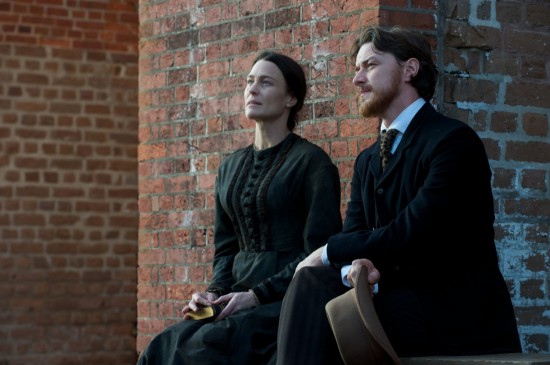
The Conspirator's fact-based plot couldn't be more promising as the basis for a riveting film: Following an opening sequence that shows the assassination of President Lincoln at Ford's Theater, along with the attempted murder of Secretary of State Seward and Vice President Johnson, the film tells the story of Frederick Aiken (James McAvoy), a Civil War veteran and lawyer newly employed by Senator Reverdy Johnson of Maryland (Tom Wilkinson). Johnson arranges the defense of the conspirators who plotted Lincoln's assassination, one of whom is a woman, Mary Surratt (Robin Wright). Surratt owned a boarding house where the conspirators were known to have met, but her role in the conspiracy itself is hazy at best. Johnson tasks the reluctant Aiken with defending Surratt, who proves to be an opaque figure that refuses to readily explicate the nature of her role and her relationship to the conspirators. Aiken encounters further opacity in the form of the politically-expedient but extra-legal military tribunal that tries the conspirators, a body of men who are there not to analyze but to condemn. They serve at the pleasure of Secretary of War Edwin Stanton (Kevin Kline), who wants to punish the accused to help heal the nation's grief.

The Conspirator feels like a made-for-TV quickie with a larger budget. Its narrative is rushed, first and foremost. Every scene feels hurried and false, as though a large story has been assigned to a narrow time-slot, forcing arbitrary last-minute shortcuts. We are hustled through an un-thrilling depiction of the assassination, which sets up the film's dramatic situation. Surratt's quandary is established not with a sense of historicity, but with the dry tone that usually accompanies a finger-wagging lesson being impressed upon a naive or naughty audience. The parallels between the incidents portrayed in The Conspirator are too close to events occurring in our own era. That doesn't mean that they don't bear examination; it means that a film based upon those incidents is going to have to fight not to look cheesy, forced, and obvious. The Conspirator doesn't fight hard enough.

Although he's the protagonist, we don't know much about Aiken's interior life - even though, during the film, he undergoes a serious intellectual and moral challenge. He is a Civil War veteran who desperately wants to see the conspirators punished, and at first he unquestioningly assumes Surratt's guilt. Despite a deep desire to see her hang with the rest, Aiken begins to suspect that the trial is not Constitutional. Yet we don't know what he's thinking or feeling, especially regarding the transition he experiences. I don't think this is McAvoy's fault, although I will say that his entire performance seems cribbed from the Tom Cruise Playbook of Mannerism and Line Reading. It's the script's fault. It's unacceptable that a highly conflicted protagonist should remain so veiled, when his thought process and emotional experience is really what the film wants to be about. Other characters are given more careful exploration, both by the script and by the actors who portray them, particularly Surratt, whose screen time and dialogue is relatively minimal, but whose presence, in the form of Wright, is dominant.

But the movie is too bogged down in earnest political philosophizing to ever become a truly character-driven drama. The movie's argument is clear within its first half-hour: military tribunals thwart the rights of US citizens. As post-9/11 Americans, we are familiar with this argument and the issues that surround it. The parallels are obvious. A feature film that deals with political topics has the opportunity to play out ideas in a dramatic fashion, illustrating abstractions and principles in terms of human lives and relationships. But The Conspirator doesn't go past the level of chat show talking points: military tribunals are wrong; Surratt may have been wrongly executed; Aiken was transformed by his realization that Constitutional rights belong to every citizen. These concepts are easily summarized, as I have just done. It doesn't take a movie to explicate them.


4.12.2011

The Heedless Overuse of Certain Words: Start-Up

If you are a small business owner and are serious about your work, never use this term. 

Here in Silicon Valley, we originate and perpetuate our own brand of bullshit. Words that sound like they indicate "business" or "money" or "technology" are released from the Valley of Heart's Delight onto an unsuspecting nation that has lulled itself complacent with the common parlance. This phenomenon bloomed to maturity in the 1990s, of course, when Silicon Valley ruled an imaginary kingdom of wealth and beauty - a kingdom that only recently fell apart, but which lives on in the hearts and minds of the people here as a high watermark left behind by the destructive power of the imagination and the human capacity for self-delusion. 

During that era of greedy innocence, one term that was loosed like a mighty falcon across the vast plain of tech-boom hyperbole was "start-up."

"Start-up" inspires many questions, including the following:

  • What does it start? 
  • When does it start? 
  • What does it look like?
  • Does it only start and never stop? 
  • Does it only start and not do anything else?
  • Is it a thing I can put in my pocket (sounds small)? 
  • Is it a place to buy things? 
  • Does it make money? 
  • Who does it make money for? 
  • Will I like it? 
  • Is it a place where mature adults apply skill and talent to solving problems through industry and commerce?
  • Can I get it to turn into something else - for example, a profitable and practical business?
  • Is it just a bunch of guys eating Tofutti and playing with Hacky Sacks? 
  • Is it something that exists only in the mind? 
The short answer to the last question is "yes" (elaboration to follow in a bit).
    The funny thing about "start-up" is how amateurish it sounds if you stop and take it at face value. It sounds like some guys in a basement, just fucking around with some stuff. And yet the connotation is that it is a heavily-funded venture that is certain to blow up into a massive enterprise in no time. 

    But what "start-up" actually means is this: a group of fast-talking tools who are working to gather the balls to pitch their concept to so-called venture capitalists and convince them to fund the operation to a certain extent, despite the fact that said concept only exists in their minds and has not sustained anything like the rigors of the marketplace.

    So yes, a "start-up" is a thing: it is nothing more or less than a shared delusion.


    And here is why: Because someone might decide to give a few hundred thousand - or several million - dollars to someone who persuades them to do so. Because "start-up" actually means a business that is not a business - it's an organization that has not weathered the true tests a money-making enterprise must take and continue to take, nor has it been subject to a pragmatic decision-making process that transforms initiative into marketplace viability.

    The fact that start-ups were a common feature of the wholly-absurd technology boom of the 1990s is not a surprise. The concept fits well with the opportunistic salesmen and wide-eyed techies who drove that period with a surreal combination of technical skill and mystifyingly retarded social skills.


    But now that we have seen the long-term damage wrought by that era of heedless, jingoistic fantasia, there is no excuse for the term "start-up" to exist at all, let alone the fact of start-ups themselves - entities that attract "investors" by virtue of mere rhetoric.


    As is always the case, the perversion lies not with the words themselves but with the thoughts that inspire their use.

    4.11.2011

    On DVD: Inferno


    Dario Argento is a filmmaker whose work is easy to appreciate but difficult to love. He is easy to appreciate because his movies are the product of a specific vision and a unique, influential aesthetic. Argento's neon-lit sets and moody, Lovecraft-infused plots have atmosphere to spare. Yet he is difficult to love because his brand of horror, although suspenseful and engaging, is devoid of emotional content. His characters are often types - innocent virginal women and naïve, confused men - cast merely as the vulnerable targets of evil predators. There is little psychology or personality driving Argento's films - other than the director's own. 

    Inferno starts out strongly, with a voice intoning the mythological premise of an ancient book known as "The Three Mothers." We learn that three evil sisters secretly rule the world from lairs constructed specifically to harness their special powers. In New York, Rose (Irene Miracle) discovers that she may be living in one of these lairs - an old Gothic apartment building. She sends a letter to alert her brother Mark (Leigh McCloskey), a music student living in Rome. The letter finds its way into the hands of Mark's classmate Sara (Eleonora Giorgi), which in turn brings her to a tragic fate. Mark finds his way back to New York, but is too late to help his sister, who has already been found by the evil forces she has accidentally unleashed.


    As an exercise in style, Inferno has a hermetic perfection about it. The visual method is characterized by large swathes of color (washes of light, spans of empty wall space, unusually large doors and windows) and graceful camera movements that always maintain compositional integrity. Argento creates his own visual grammar.


    But Argento is somewhat undone by the characters he creates - one-dimensional types who don't have inner lives to speak of, nor are we ever certain that they have much comprehension of what is happening to and around them. This makes it difficult to empathize with them. If characters on-screen have some grasp of the plot (even when we don't), this makes it easy to forgive plot holes. We follow stories based on characters' experiences. It's never very clear that Rose or Mark understand that evil has been let loose in their world - and that might be acceptable if we knew that they know or don't know. Inferno leaves its characters in the lurch, however, without establishing clarity as to the protagonists' relationship to the horror they face. And this causes the film to lose momentum in its second half.


    It's a shame that Inferno isn't strong enough to deliver on its many interesting ideas. Ultimately, a film's ideas need to be enshrined somewhere concrete within the film - and most often that place is within its characters. But Argento relies too heavily on visual technique, which, while impressive and often arresting, can't undo the awkwardness of characters who have been abandoned at the film's center. 

    Read the full review here

    On DVD: The Tourist


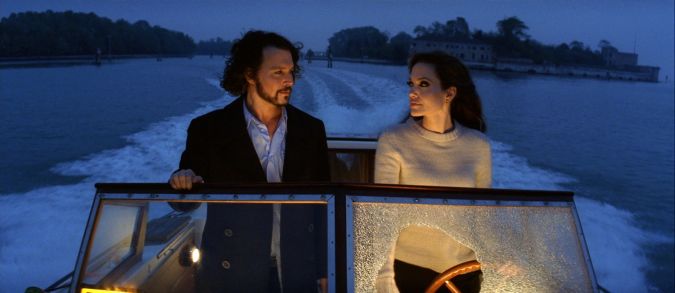
    The Tourist is beautifully shot by the accomplished Oscar-winner John Seale. It captures classically romantic locations like Paris and Venice with a visual caress lacking in Hollywood productions for some time. The look of the film reminds us not so much of the gritty Bourne series as much as David Lean's Summertime and Stanley Donen's Charade. Unfortunately, the comparisons end there. As much as The Tourist attempts to capture not just the look but the tone of those and other jet-setting comic thrillers of the past, it fails to generate tension or laughs. In fact, the picture is just another big-budget dud of the type we have come to expect from studio tent pole projects these days.

    The freakish Angelina Jolie - who I'm certain will later be remembered as a sort of female Victor Mature, with her exaggerated, artificial good looks - plays Elise Ward, a mysterious Englishwoman being pursued by a number of international police agencies, all of whom are hoping she will lead them to the shadowy master criminal Alexander Pearce. On a train to Venice, she selects Frank (Johnny Depp) as a decoy for Pearce, and takes him along on her jaunt across Europe. A series of twists and turns allow the leads to have some fun with power-play reversals - and then all of a sudden we're supposed to believe that romance is blooming between the two. The rest of the film is a leaden chase, stunted by the leads coming off as virtual ciphers with no emotional lives or explicit goals.

    The Tourist is a big mess with high production values. The fact that it is visually successful proves that the film was better-prepared than the shoddy, misshapen script would suggest. It had to have been thoroughly storyboarded. Yet the script, credited to director Florian Henckel von Donnersmarck as well as Oscar-winners Christopher McQuarrie and Julian Fellowes (and based on the well-reviewed but little-seen French film Anthony Zimmer from 2005), tries too hard to capture a classy retro mood and scenario rather than reaching for a clear notion of its leading characters. And even that fussed-over scenario lacks credibility. An early scene in which a Scotland Yard investigator pieces together bits of a note Ward had burned to a crisp is handled with a ridiculous observational straightforwardness, instead of being the comical take on spycraft it could have been. Whether or not the technology exists, its portrayal lacks all plausibility. Also, it's worth pointing out that the chief reason Pearce is being pursued by so many different agencies is because he owes the British government back taxes!


    Jolie is like a Jordan almond. You think this nice-looking candy treat is going to be sweet and delicious, but really it's just weird idea that turns out to be bland. Depp continues his pursuit of projects that provide overexposure without the balancing benefit of furthering his range of characterizations - or utilizing his talent at all, for that matter. Both actors are charisma-free in The Tourist. The movie's lush production values, in addition to allowing DP Seale to capture some of the most iconic vistas in Europe, affords an engaging score by James Newton Howard. In all other respects, The Tourist is a shamefully expensive wreck of a movie. 

    Read the full review here

    4.07.2011

    The Heedless Overuse of Certain Words: Definitely

    An ongoing concern of mine is the mangling and perversion of the English language by those who do not think before they speak. It's alarming and unsettling how commonly and naturally people are lulled into a sense of verbal complacency. I refer generally to many things here as they pertain to spoken English, but one of them is overuse of words as symptomatic of a corroded verbal culture. I don't believe that the chronic overuse of particular words is a product of limited brain function, but rather the result of an environment in which words are simply not valued for their communicative power. This leads to words being sapped of strength and meaning, and in this way,  spoken communication can be rendered not only lifeless but purposeless.

    A concrete example of what I'm referring to can be seen in the heedless overuse of the word "definitely."


    Before I begin, I should point out that the case of the word "definitely" is very possibly localized to California and/or the West Coast.  I have lived other places, and I do not hear the word used elsewhere in the same sense that it is typically used in this region.

    What I mean to talk about is the word "definitely" being used to indicate unnecessary emphasis that, when thus applied, comes off as somewhere between disingenuous and dishonest:


    "We should definitely get together."

    "I'll definitely try to be there."

    "We definitely loved your performance art!"

    Or, simply, and most commonly:

    "Yeah, definitely!"

    The false emphasis of "definitely" is a linguistic perversion of the most insidious kind.  What is insidious about it is the fact that the word is used to mean something that is virtually the opposite of what it should normally indicate.  "Definitely" does not mean "with certainty," but rather something closer to: "I would like to bring about some positive personal transaction, but really can't be bothered to do so in a genuine way, so I'll just insert this emphatic word that indicates intentions that I'd like you, the listener, to perceive."


    The use of "definitely" in this sense isn't restricted to socially awkward teens or self-absorbed college kids. It's used by older adults. It's used by "'professionals." It's used by people old enough to know better.


    In the case of "definitely," and in many others, the multi-layered nature of its misuse isn't just an affront to some idealized notion of linguistic felicity.  By using "definitely" to mean the equivalent of "almost definitely not," we offend each other. We insult our auditors' intelligence, and degrade our individual ability to communicate - because o
    nce we stop thinking about and meaning what we say, we cease to be ourselves entirely.