4.22.2011

News: Current Projects

I recently stopped doing disc reviews for DVD Talk after two years and 190 reviews. (I am continuing to provide reviews of new theatrical releases on an occasional basis.) This decision was only a pragmatic one; I love writing for the site and being among the illustrious company of so many good and thoughtful writers.

I dropped disc reviews in favor of personal projects that have for too long been simmering quietly on back burners.

Those projects are:

1) My first comics script. It's a standalone graphic novel. My friend Bridget is doing the artwork. The script is nearly complete, and Bridget has begun work on character design. We are both very excited about it. It's a silent comic. The story concerns a man and a woman - strangers to one another - who are stranded in mid-20s ennui, groping their way through a variety of challenges while struggling to attain expanded perspectives and fuller, more authentic lives.

2) A series of interviews collectively titled "How Did You Do It?" The series is intended as an ongoing group of case studies that document the myriad ways people in the creative arts build their careers. Since artists don't have a codified, professionalized path laid out for them in advance, they usually have to find their own way. This series will serve as a corrective to the simplistic, ready-made "advice" available to artists in lazy, self-help-type books that ignore the realities and consequences of following your creative instincts. I recently interviewed Maria Bamford and Tom Shadyac for the series, and have already scheduled additional interviews. Now it's just a matter of getting them into print.

3) A screenplay about a family that experiences the many changes in Silicon Valley life that take place during the PC revolution of the early 1980s. This story has been germinating for almost two years. I had begun a draft, but realized after about 30 pages that the story wasn't all there yet. So I went back and started outlining more heavily. Now, I have a 15-page narrative outline that encompasses much more in the way of plot and character development. I have a few more weeks of outline work before I'll be ready to write a complete first draft.

This is the most productive - creatively - that I have been in ten years. It's barely a first step toward a writing career, but it's something. Besides, getting shit done is the most satisfying thing of all.

Note: The picture above shows the novelist Edna O'Brien's writing room, which shares many characteristics with my own imagined future office. The photo comes from The Guardian's great series on writer's rooms.

4.20.2011

Event: Daniel Clowes at Bookshop Santa Cruz

Last night, my wife and I went to go listen to Daniel Clowes talk about his new book, "Mister Wonderful," an expansion of a serial strip that appeared in The New York Times Magazine a few years ago. The book is nothing less than vintage Clowes: a deceptively simple character study of Marshall, a middle-aged bachelor out on the town for a blind date that may very well be his last chance at love. Marshall's story is sweeter than the kinds of tales Clowes is known for - that is, it's sweeter on the surface. Because just below that surface bubbles a hidden reservoir of self-destructive tendencies. For starters, Marshall admits to having a problem with his temper. But perhaps most important is Marshall's self-absorbed narration, which dominates the book's action. Clowes renders Marshall's "voice-over" in heavy blocks of text that often obscure other characters' dialogue and faces - a concrete graphic representation of Marshall's neuroses.

Clowes' presentation featured the author standing at a lectern in front of an audience of about 35 people; an assistant manned a laptop computer, which fed a PowerPoint presentation to a projector. Aided by the slides, Clowes reviewed his career briefly before launching into a more detailed discussion of "Mister Wonderful"'s genesis in The New York Times Magazine and how he arranged and added to the story for the book.  Clowes focused mostly on anecdotes about his experience working for the Times, and on his own storytelling techniques.

As witty and enlightening as Clowes was, one of the evening's highlights came courtesy of a questioner in the audience. In fact, it was this exchange that kicked off the Q&A following Clowes' talk:

Questioner (a middle-aged hippie lady, standing in the back of the room in a neon green jacket, and a weird faux-Indiana Jones hat): Who are you? (pause) I'm sorry - I mean, what have you written?  What was your first book?

Clowes: Did you miss the presentation?

Q: I'm sorry. I just came in.

Clowes: My best-known book is called "Ghost World." It's about ghosts.

Q: Oh, okay.

Clowes: Just kidding. It's about two girls. People want it to be about ghosts, but then I tell them it's about two girls and they're like, "Oh..."

Q: Should I read that first?

Clowes: You should buy all my books. I can tell you'll like them just by looking at you.

It was a very Clowesian moment, to have his presentation capped by a question from someone who had no clue what was going on. Thankfully, the remainder of the questions weren't quite so "Santa Cruz" in nature.  

The remainder of Clowes' tour dates can be found here.

4.18.2011

Essay: Ode to Sweets

I have an insatiable sweet tooth. In the morning, I wake up wanting only toast with jam despite the ill-advised carbs and sodium contained therein. When I arrive at work, I make a double espresso and it's hard work to resist the candy and other snacks that are freely available in the office kitchen. At least three days a week, I get lunch at Jamba Juice, where I consume a small smoothie and oatmeal topped with a sweet compote of apples and brown sugar. On the walk back to the office, I often stop in the kitchen for Fig Newtons, M&Ms, or cookies. At 3:30 every day, I take a sanity break. I walk downstairs, fix a cup of tea, and take it outside to the back patio with cookies.  When I leave the office for the day, I usually stop by the receptionist's desk (she's already left by then) for a quick fistful of whatever's in her candy dish. After dinner, if we're out of brownies and mochi, I'll eat the bulk chocolate that's kept with the baking stuff in our kitchen cabinets.

First of all, I'm lucky that my weight is at least within the normal range (even if it's on the high end). I'm lucky I'm not diabetic (although that may very well be coming). I'm lucky I don't have dentures (my grandmother, from whom I'm convinced I inherited this weakness for sweets, lost most of her teeth by the time she had kids).


I will eat pastries, cake, cookies, ice cream, candy, and chocolate with reckless abandon at nearly every given opportunity. Over the past year, I have reined it in somewhat and yet my typical day, as described above, still consists of eat least three stops specifically for sweet snacks. I would rather skip protein and have pie instead. I would prefer ice cream to dinner. I've been known to make my own lemon curd. One of my specialties is a many-layered trifle. I make fruit pies in the summer, fudge at Christmas, and cookies and brownies on a year-round basis. If you get too close, I will stuff you with sugar and butter.


Now that the weather is warmer, I want to try my hand at ice cream. I remember my parents making it in an old wooden barrel-like thing with a loud, crotchety electric motor attached. This contraption required that one add salt and ice continuously over an extended period of time. I know that technology has improved matters and now the process it not as arduous and physical. However, I must research what the preferred methodology is, nowadays. I wish for nothing quite so much this summer as the finest peach ice cream made with freshly-picked fruit.

Essay: The Function of Wealth in Silicon Valley

Readers of this blog will know that I take grave issue with the dominant culture - or lack thereof - in my hometown of San Jose, California, the self-proclaimed "capital of Silicon Valley."  Like many people, I have a strong love-hate, push-pull feeling about my town. Living in other parts of the country has given me some extra perspective on the place I am from - a place that I mostly took at face value well into my twenties. I know what San Jose once was: a near-paradise of sorts, lush with fruit orchards and craftsman-style houses, both of which were still visible in remnant forms when I was growing up. And I know what San Jose is now: a crushing, treeless sprawl of imagination-free tract homes and shopping centers, and a Mecca for the consumption-obsessed.

Everyone knows that Silicon Valley is a place where people earn above-average wages, and where it also costs a lot to live.  Necessities may be more expensive than elsewhere, but necessities aren't the problem. It's the luxuries that baffle the mind and disgust the senses. In Silicon Valley, money is wasted on a gargantuan scale, on things that do nothing but depreciate in value. Instead of property, art, or travel, people tend to "invest" in cars, electronics, trips to Vegas (which do not count as "travel"), and other nonsense.  Even in this economy, Silicon Valley remains nothing if not an enormous accumulation of wealth. That wealth is visibly tied up in the
outrĂ© symbols of conspicuous consumption - gargantuan and grotesque houses, expensive cars,  tasteless glitz and glam and bling worn on the body, and snide, obnoxious, entitled, socially-unacceptable behavior of many varieties. 

Look around you. Everyone is driving a BMW, a Lexus, or a Mercedes - if not a gas-guzzling, herpes-infected SUV of some kind. People grocery-shop at Whole Foods and Draeger's and Andronico's. Everyone has a gigantic television with a surround sound system. People own a lot of recreational equipment: gigantic RVs (houses on wheels, with all the conveniences of regular houses, only powered by huge amounts of fuel), jet-skis (those idiotic, noisy relics of the 1980s), power boats, and dirt bikes. These vehicles do not, as their owners and proponents will say, encourage an appreciation of nature or exposure to the great outdoors.  They are merely obscene, obstreperous noise-makers designed to advertise the wealth and testicular insecurity of their owners.

At the same time, Silicon Valley is marked by a dearth of fine arts institutions, a cash-strapped and land-poor parks system, and terrible architecture.


This is what the so-called "triumph of the nerds" has wrought. Geeks might be bright, creative, interesting people. But their sense of civic duty or pride is zero, and their taste is worse. They pour their money into selfish, absurd trifles at the expense of their neighbors' quality of life. They live on hillsides and shut themselves off from real life. Their wives are made of plastic and their children are soulless misfits.

Since the geeks' money is tied up in material garbage or sitting in a bank someplace, it has not - and never has - found its way back into the valley that gave it to them in the first place. Our schools and other institutions suffer because of it. Our culture is a big fat zero. My experience working for area non-profit organizations taught me that the generosity of our local population is a prickly and elusive beast; raising money for cultural institutions in Silicon Valley is a challenge of demoralizing proportions.


I'm not just talking about "charity," either. I'm talking about something much bigger and much more important. I'm talking about the vision necessary to make good use of wealth. That vision starts not with charitable organizations, nor with corporations who want to make a good name for themselves by funding some cause or other. The vision must start and be owned by individuals who have the means to make a difference. They must first understand the size of their estate and the potential their wealth represents. Maybe these geeks should be forced to take the undergraduate courses that they skipped before having access to six-figure salaries and stock options: sociology, economics, art history, and geography. Then maybe they will begin to be equipped with the skills and knowledge necessary for the building of a great society.

This is, ultimately, a typical "new money" problem. People who suddenly find themselves rich literally don't know what to do with their money and are prone to wastefulness. Indulgence is understandable - for a while. But we are past this point. Silicon Valley residents at all income levels must be made aware of the potential of the vast resources we have access to, and those resources must be turned toward the greater benefit of what should be a robust and rounded culture. A great society doesn't require a utopian superstructure to manage class divisions; it requires the wealthy to understand that they bear the burden of a special responsibility - not necessarily the redistribution of their wealth, but the responsibility to make use of it for the greater good.

4.15.2011

In Theaters: The Conspirator


As an actor, producer, and director, Robert Redford's contribution to film is marked by close, thoughtful preparation, detailed pre-production, and polished execution. Although no one's filmography is flop-free, Redford's best films are marked by tight scripts, excellent casting, and a shot-by-shot flow that suggests precise storyboarding and pre-visualization. On The Conspirator, Redford serves as director and one of eight credited producers, and the surprise of the film is its sloppiness and the feeling that the entire project was rushed through production. The Conspirator suffers from an underdeveloped script, miscasting, and a perfunctory visual style. Nothing about the film suggests the involvement of Robert Redford - or any director with decent narrative sense or a judicious eye. The Conspirator is a flavorless political statement in the guise of a historical drama. It could have been directed by anyone - or, for that matter, by a committee of dullards.

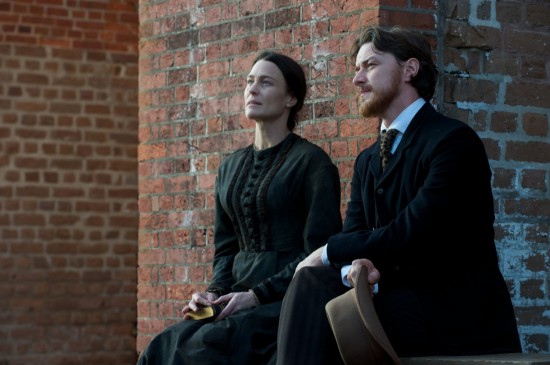
The Conspirator's fact-based plot couldn't be more promising as the basis for a riveting film: Following an opening sequence that shows the assassination of President Lincoln at Ford's Theater, along with the attempted murder of Secretary of State Seward and Vice President Johnson, the film tells the story of Frederick Aiken (James McAvoy), a Civil War veteran and lawyer newly employed by Senator Reverdy Johnson of Maryland (Tom Wilkinson). Johnson arranges the defense of the conspirators who plotted Lincoln's assassination, one of whom is a woman, Mary Surratt (Robin Wright). Surratt owned a boarding house where the conspirators were known to have met, but her role in the conspiracy itself is hazy at best. Johnson tasks the reluctant Aiken with defending Surratt, who proves to be an opaque figure that refuses to readily explicate the nature of her role and her relationship to the conspirators. Aiken encounters further opacity in the form of the politically-expedient but extra-legal military tribunal that tries the conspirators, a body of men who are there not to analyze but to condemn. They serve at the pleasure of Secretary of War Edwin Stanton (Kevin Kline), who wants to punish the accused to help heal the nation's grief.

The Conspirator feels like a made-for-TV quickie with a larger budget. Its narrative is rushed, first and foremost. Every scene feels hurried and false, as though a large story has been assigned to a narrow time-slot, forcing arbitrary last-minute shortcuts. We are hustled through an un-thrilling depiction of the assassination, which sets up the film's dramatic situation. Surratt's quandary is established not with a sense of historicity, but with the dry tone that usually accompanies a finger-wagging lesson being impressed upon a naive or naughty audience. The parallels between the incidents portrayed in The Conspirator are too close to events occurring in our own era. That doesn't mean that they don't bear examination; it means that a film based upon those incidents is going to have to fight not to look cheesy, forced, and obvious. The Conspirator doesn't fight hard enough.

Although he's the protagonist, we don't know much about Aiken's interior life - even though, during the film, he undergoes a serious intellectual and moral challenge. He is a Civil War veteran who desperately wants to see the conspirators punished, and at first he unquestioningly assumes Surratt's guilt. Despite a deep desire to see her hang with the rest, Aiken begins to suspect that the trial is not Constitutional. Yet we don't know what he's thinking or feeling, especially regarding the transition he experiences. I don't think this is McAvoy's fault, although I will say that his entire performance seems cribbed from the Tom Cruise Playbook of Mannerism and Line Reading. It's the script's fault. It's unacceptable that a highly conflicted protagonist should remain so veiled, when his thought process and emotional experience is really what the film wants to be about. Other characters are given more careful exploration, both by the script and by the actors who portray them, particularly Surratt, whose screen time and dialogue is relatively minimal, but whose presence, in the form of Wright, is dominant.

But the movie is too bogged down in earnest political philosophizing to ever become a truly character-driven drama. The movie's argument is clear within its first half-hour: military tribunals thwart the rights of US citizens. As post-9/11 Americans, we are familiar with this argument and the issues that surround it. The parallels are obvious. A feature film that deals with political topics has the opportunity to play out ideas in a dramatic fashion, illustrating abstractions and principles in terms of human lives and relationships. But The Conspirator doesn't go past the level of chat show talking points: military tribunals are wrong; Surratt may have been wrongly executed; Aiken was transformed by his realization that Constitutional rights belong to every citizen. These concepts are easily summarized, as I have just done. It doesn't take a movie to explicate them.