8.31.2010

On DVD: Prime Suspct: The Complete Collection


Detective Chief Inspector Jane Tennison is an intense, driven, flawed alcoholic who meets sexism and harassment on the job with determination and a sense of political saavy. Not only is she technically shrewd, she is also a fine, highly intuitive detective who feels her way toward the truth, occasionally stumbling over her personal and professional faults - all of which make her one of the most convincing and indelible fictional detectives ever portrayed. Through the seven installments of Prime Suspect, Helen Mirren shapes this complex character, making an equally exorbitant investment in Tennison's self-destructive tendencies and her talent for police work.

This series of seven long, multi-part films, originally broadcast on ITV in the UK and on PBS's Masterpiece Theatre here in the US, comprise no less than some of the finest crime drama ever televised. Although there are traces of the great British traditions of crime fiction here and there, Prime Suspect has a distinctive style marked by a focus on character and dire, bleak atmospherics. Gray skies, concrete police buildings and housing estates, and the fluorescent lights of cheap offices and municipal morgues are the visual signals that tell us we're neck-deep in police work. Yet it's a far more grim and realistic look than the brighter colors of, say, Law and Order.

But the real distinguishing features of all seven series of Prime Suspect are the writing and the acting. Creator Lynda La Plante wrote the first and third installments, establishing the major characters and tone of the show. Tennison is an outsider, a woman working in a man's world, a fact that drives her professional successes just as it contributes to regular flare-ups of her personal flaws. Particularly during the earlier series, Tennison is beset by a variety of forces that plague her career, originating in the criminal world and among her own colleagues. Prime Suspect's second major character, appearing in the first, third, and seventh series, is Tennison's chief antagonist and colleague, Detective Sergeant Bill Otley, played with a cadaverous, withering smarminess by Tom Bell. Sexist, treacherous, and threatened by Tennison's talent, Otley works hard through the first and third series to discredit Tennison, hoping to have her removed from his supervision. Otley's adversarial - and, at times, outright illegal - behavior drives Tennison to further excel at her job - and to drink excessively off-duty. Her relationships with men, at times healthy and at times not, are always short-lived, thanks to her professional commitment and dependence upon booze.

Mirren and Bell are joined by a parade of fine actors in roles both large and small. Tom Wilkinson appears in the first series as Tennison's kind but ultimately defeated boyfriend. Ralph Fiennes is in it as well, but too briefly to merit the placement his name receives on the DVD packaging. The third series alone includes performances by David Thewlis, Ciaran Hinds, Mark Strong, and Jonny Lee Miller. Frank Finlay appears in the last two installments as Tennison's father. In short, much of the first rank of contemporary British actors makes their way through the series at some point.

The storylines of each installment of Prime Suspect are consistently compelling and often genuinely unpredictable, particularly by the standards of the average crime drama. The first series begins with a relatively straightforward rape and murder, but the suspect is anything but usual: when Tennison first catches up with George Marlow (played by John Bowe), his guilt is anything but clear. We are unsure whether Marlow is the killer, or if Tennison's ambition has gotten the better of her. In addition to the usual murder or two, future series attack pressing and touchy social issues such as racism, child prostitution, drugs and gangs, and war crimes stemming from the Yugoslav Wars of the 1990s. In each case, plots move swiftly and are often ingeniously constructed. Only very occasionally do the machinations of the mystery genre reveal their cogs and wheels.

But the real heart and soul of Prime Suspect is Mirren as Jane Tennison. It's the tension she generates as an unpredictable but brilliant loose cannon that keeps us riveted to each and every minute of this outstanding series. Tennison's flaws - her alcoholism, occasional irrationality, and her struggle with double-edged "female" instincts - keep the character on the fence, hovering between blockbuster success and the danger of failure. We can't always predict that she'll do the right thing - and even when she chooses the proper path, her behavior upon it can be reckless and self-destructive in the pursuit of solving a case, proving a point, or simply spiting antagonistic colleagues such as the intolerant and dangerous Otley. In maintaining our interest in Tennison, her missteps are as important as her wiser maneuvers. They keep her human, plausible, and accessible. 

Read the full review here

8.24.2010

Essay: Tim Burton in Blunderland - An Addendum


After writing about Tim Burton a week or so ago, I felt obliged to see his Alice in Wonderland from earlier this year despite extremely low expectations, if only because it’s the only film of Burton’s that I had not yet seen.  As I said, my expectations were already buried so deep they were treading water – and yet, amazingly, they were not met.  

Burton’s version of Alice isn’t so much “re-imagined” as it is ground up into disgusting, incoherent chunks which are then lobbed indiscriminately at an unsuspecting and malnourished audience.  Despite a very shaky decade of work, Burton’s films up to this point have at least reflected the director’s unique adherence to bizarre and often beautiful design work.  But Alice is Burton’s first downright ugly film, with a color scheme that looks like a kindergarten classroom minus the fun and sense of possiblity.  The hideous CGI work saps the scenery of appeal and personality, which is especially regrettable given that Burton’s reputation was originally built upon a hand-crafted style that favored miniatures and stop-motion.  


Strangely, there are cameo appearances by the twisted tree and windmill from Sleepy Hollow – one of Burton’s best visual achievements and dullest stories.  It’s as if they were included here to remind you of who directed the film, because there is almost no other evidence of Burton’s involvement.  The CGI environments of Alice are slapdash and phony – colder and less imaginative than those of Avatar, a film I don’t admire but enjoyed more than this hash.  The look of Alice is further proof that Burton’s work on the film could only have been in the capacity of hired gun, no doubt receiving a hefty paycheck from Disney to churn out a new version of a very old studio-owned property.

The story represents a wholly unnecessary diversion from the source novels by Lewis Carroll.  The script takes a weird turn and casts an older Alice as some kind of amnesiac who has forgotten her earlier trip down the rabbit hole, and now finds herself back in “Underland” trying to defeat the Red Queen.  The total effect is incoherence, as the script recycles Carroll’s material in a way that parallels the original story without exactly replicating it.  It’s a confusing choice, without logic, that renders Carroll’s wonderful work inert.

As Alice, newcomer Mia Wasikowska holds her own against an onslaught of mostly invisible co-stars.  She’s lovely and talented, yet somehow miscast.  Perhaps she’s too lovely for the part – and not scrappy enough?  I’m not sure.  Wasikowska is good in the role, but without being right for it.  


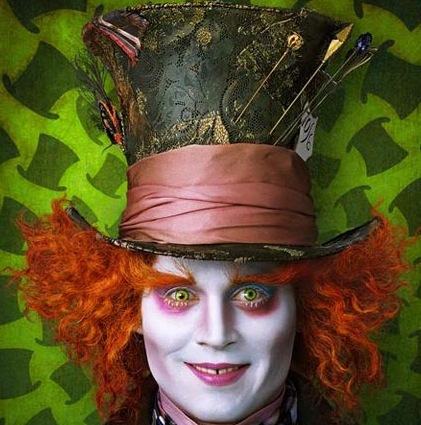
Johnny Depp plays the Mad Hatter as another in a series of roles that call for the actor to cast aside a large part of his considerable talent and play a mannered buffoon.  Sometimes he’s quite good at this – especially when the script calls for it.  But Alice’s script is poor to begin with, and his role in particular bears evidence of artificial “enhancement” for the sake of its star.

The only thing reminding us that we are in Burton country is Danny Elfman, whose score is dependably pleasant if not revolutionary.  The quality Elfman’s score is all the more interesting for having been inspired by such a terrible film.

And in the end, that’s all it is: terrible.  Devoid even of the merest flashes of creativity, Tim Burton’s Alice in Wonderland has made me reconsider the “appeal” portion of my earlier post.  Instead of trusting in his own storytelling instincts, I think Tim Burton should take a hard look at what he has been producing.  Certainly, he can’t need more money.  And I find it hard to believe that he simply "enjoys working" – especially since he’s one of the few directors who have the kind of pull to get their own projects off the ground.  Maybe Burton needs to take a break – there’s no doubt that I need one from him.

On DVD: The Simpsons: The Complete Thirteenth Season


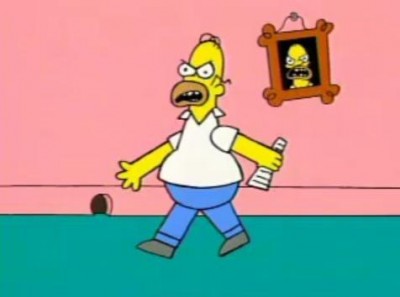
Reviewing the thirteenth season of The Simpsons, I feel more in danger of repeating myself than ever before. Last year, I wrote about the series' good but not great twelfth season, with an acute awareness that the show had begun a slow but irrevocable death spiral. Although the twelfth season remains amusing and entertaining on the whole, there's a change in feel and a reduced focus on character. Still unsure as to what I should reasonably attribute The Simpsons' unmistakable decline in overall quality - Changes in show management? New writers? The rise of Seth MacFarlane? - the thirteenth season is further proof of the regrettable change in comic tone that the series took on in the early part of the last decade. More important than the uptick in one-off jokes and shock gags is the fact that The Simpsons begins to repeat itself quite unapologetically. The thirteenth season contains a surprising number of jokes and situations recycled from earlier episodes; these aren't clever inside references for fans, either - the show's makers were simply re-using old material and hoping we wouldn't notice. 

Despite several good scripts by the prolific and consistent John Swartzwelder, The Simpsons' style takes a turn into territory that is clearly - and unfortunately - influenced by Family Guy, a place where throwaway jokes lead to hyperlinked mini-scenes of the "It's like the time Yogi Berra had cocktails with Yoda" variety. It's strange to reflect on the perverse injustice of The Simpsons being so impacted by Family Guy - a show that began life as a transparent rip-off of The Simpsons, but with gross-out jokes. Both are Fox properties, which likely had something to do with it - although that doesn't explain it, exactly, because Family Guy had poor ratings in its first two seasons, after which it was temporarily cancelled by Fox. Maybe staff at The Simpsons saw Family Guy as the way of the future and consciously tried to piggyback elements of its style. The true explanation lies well outside the purview of this review, but the fact is that the influence of Family Guy is an important factor in the show's changing tone.

At the beginning of this year, Fox released The Simpsons: The Complete Twentieth Season on DVD and Blu-ray in an opportunistic attempt to capitalize upon the show's first high-definition season. In reviewing season twenty, my multi-talented colleague at DVD Talk, Jamie S. Rich, wrote a warm, honest, and very funny break-up letter to the series, citing its frustrating decline in wit and inventiveness. In a lot of ways, many of Jamie's observations apply directly in the case of the thirteenth season. The fact is, I stopped watching the show regularly around 2001, and it was my first time seeing many of these episodes. I was reminded all over again of how I felt a decade ago: that the show had grown stale, repetitive, and overly reliant upon its reputation and past brilliance.

From the vantage point of ten years on, The Simpsons' thirteenth season looks like a show caught in the midst of an uncomfortable identity crisis. It's impossible to argue with the ingenious entertainment that The Simpsons generated without exception for a good solid ten years. Any program that stays on for twenty - and almost none do - is bound to struggle with freshness. The thirteenth season offers its fair share of laughs - especially in the episodes "A Hunka Hunka Burns in Love," "She of Little Faith," and "I am Furious (Yellow)" - but our main characters no longer drive the stories the way they used to. The long and short of it is that The Simpsons remains recognizable and entertaining in the thirteenth of its (so far) 21 seasons, yet this isn't the family we fell in love with. 

Read the full review here

8.20.2010

On DVD: TCM Spotlight: Errol Flynn Adventures


Turner Classic Movies and Warner Brothers have teamed up to issue a new edition of the TCM Spotlight series, this time a five-film set of WWII-era action pictures starring Errol Flynn. Although highly propagandistic on the surface, these films are quite entertaining and admirably made. Four out of the five are directed by the perennially unsung Raoul Walsh, a filmmaker of great force and economy who presaged the work of Don Siegel (who did the montages for a few of these pictures as well as Casablanca before coming into his own as a director). Walsh had an understated style but he knew how to capture complex movement and character interaction with a minimum of set-ups and cuts. His kind of talent was rare within the studio system, which forced directors to work cheap and fast, and Walsh's ability to create a fluid narrative within such constraints is enshrined here in this release just as effectively as Flynn's star power and unmatched charisma.

Desperate Journey (1942) is an enjoyable but by-the-numbers flag-waver co-starring none other than Ronald Reagan. Flynn and Reagan are two members of a bomber crew shot down over Germany and imprisoned. Of course they escape and save the day, but they grapple with Nazis galore along the way, including an evil officer played stiffly by Raymond Massey.

This is wartime entertainment at its most phony and most entertaining. Reagan is terribly chipper and one can't help feeling that what he's pleased as punch to be on the Warner Brothers lot instead of being shot at in Germany or the Pacific. Flynn is equally roguish, of course, and not much more believable as the bomber's navigator. But there's some fun action here and it's all well-shot, incorporating some decent visual effects for the era.

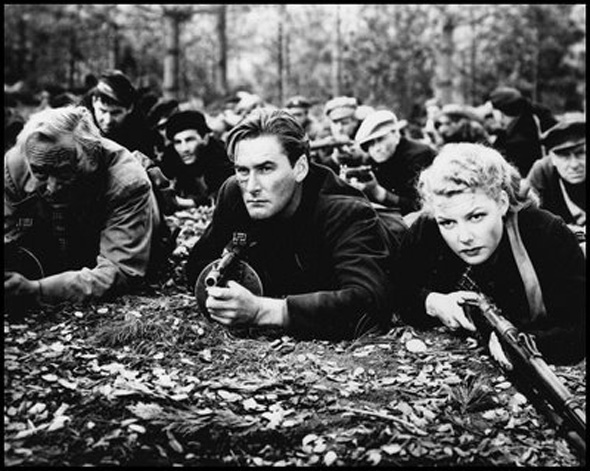
Edge of Darkness (1943) is one of the more thoughtful films in the set. Strongly - and oddly - echoing John Steinbeck's novel The Moon is Down (published the prior year), the story takes place in a Norwegian fishing village recently occupied by Nazis, but is purportedly based on a different novel, by William Woods. Most of the town's citizenry oppose the Germans' presence, even planning armed resistance. But those who wish to fight back are afraid of quislings in their midst who could turn traitor. Flynn plays one of the leaders of the secret movement, working alongside characters played by Judith Anderson and Ann Sheridan. The story portrays some interesting shades of gray in the form of characters with divided, or at least uncertain, loyalties, such as the town doctor, played by Walter Huston. Although the film's conclusion isn't exactly unconventional, the plot moves in some unexpected ways, thanks to complex characterizations and performances.

It's the only non-Walsh picture in the set. Director Lewis Milestone oversees some great sets, including a lovely miniature fjord used in wide shots. The climactic battle is energetically shot and edited. Flynn is not as front-and-center in Edge of Darkness as a star of his caliber would normally be. The movie is a genuine ensemble piece, with solid work by Huston, Anderson, and Sheridan. Sheridan in particular is strikingly forceful and aggressive as Flynn's compatriot and love interest. The only misstep in the acting department is Roman Bohnen as shopkeeper Lars Malken. Malken is a coward, but the role is over-written, and Bohnen's chattiness renders this tragic character simply annoying. Overall, however, Edge of Darkness takes its subject matter seriously, and while a tad overlong, it's probably the most thematically engaged film in this set.

Northern Pursuit (1943) places us firmly back in B-picture territory. This action thriller begins with a well-staged sequence that shows a German U-boat "dropping off" a group of spies in the Great White North. Flynn is an officer of the Royal Canadian Mounted Police who becomes suspected of collusion with the Nazis, and must escape to the far north in order to capture the spies and prove his patriotism. It's a silly story on the surface made more plausible by Walsh's taut direction and a decent screenplay by Frank Gruber and Alvah Bessie (Bessie is also responsible for the scenario of Objective, Burma! - see below).

One of Walsh's strengths is creating an immersive mise-en-scène out of limited backlot resources, a talent that is in bold evidence here. Although snowflakes fall too drily from the shoulders of our icebound characters, the cabins, sled dogs, trees, and wide shots are right in the details, and it all works together to create a credible version of Canada's northern wilds. Tension is high throughout, helped by good supporting work from Helmut Dantine - who also plays a key role in Edge of Darkness - as the lead German spy. He has a thin-lipped reptilian quality and a command of the Nazis' cold, bureaucratic outlook. Northern Pursuit also features a number of small surprises for those of us overly-familiar with genre conventions, including a implausibly crackerjack ending that involves the assembling of a bomber out of parts stored in wooden crates.

Uncertain Glory (1944) stars Flynn in one of his more unlikely roles. Here he plays a French murderer, posing as a resistance leader in order to prevent anti-resistance retaliation by the Vichy government. His chief ally is a detective played by Paul Lukas, whose Hungarian accent is as inappropriate as Flynn's Australian one. While the outcome is hardly unorthodox, the picture is never exactly by-the-numbers, either.

As in Edge of Darkness, some interesting questions of national and philosophical allegiance are raised in ways that suggest some surprisingly gray areas - especially in view of the jingoistic wartime environment in which this film was produced. It's another fun thriller from Walsh, who creates a treacherous atmosphere and strong visuals, including good use of miniatures and stock footage.

Objective, Burma! (1945) is the longest and most well-known picture in the set. It's also the only one previously-released on DVD. Here, Flynn leads an ensemble cast as Captain Nelson, who takes a group of paratroopers into Burma to destroy a Japanese radar location. The team's mission is swift and successful, but getting out of Burma proves a far bigger challenge.

The movie is a sort of "military procedural," depicting operations with what would appear to be an unusual, almost forensic level of detail. Objective, Burma!, despite its sense of authenticity and other qualities as a well-made film, is not as reliable as one would like to believe. It was famously decried - and banned - by Winston Churchill for fictionalizing a British operation as a largely American one, a matter discussed in the commentary track. But it's still a highly entertaining adventure that avoids overly romanticizing combat and instead puts the audience in the middle of the operation - which is mostly achieved by way of the character Williams (Henry Hull), a reporter on the mission and our conduit for information about the way the military works. Walsh's direction was never more assured or skillful; he uses much more camera movement and cutting here, to convey action and build suspense. 

Read the full review here

8.19.2010

News: Me and Thrifted - Partnerblogs!

I've just posted my first guest entry over at Thrifted's new blog.  An offshoot of the stupendously successful vintage fashion shop, the Thrifted blog is both a compendium of and filter for all things fashion, style, and visual culture.  That will include film, which is my bag, but I'll be writing about other stuff as well.  

My first post is on a topic of perennial fascination to me: the suburbs.  I'm a product of the suburbs and I constantly think about the place I'm from - asking myself why anyone in their right mind would want to live here, and imagining what things were like two generations ago, back when Santa Clara County was still known as the Valley of Heart's Delight for a reason (i.e., it was bursting with the fragrant blossoms of fruit trees and boasted some of the most fertile soil in the world).  

My current opinion of the greater San Jose submetroplex has deteriorated over the years, but you'll see in my post for Thrifted that it still has its selling points - and there are more beyond what I've covered here, but I'm saving those for a future sequel post.