Showing posts with label movie reviews. Show all posts

6.21.2011

On DVD: The Company Men


A topical film that grapples (somewhat aloofly) with the importance of "work" in our daily lives, The Company Men is reasonably intelligent and well-acted - and it features Kevin Costner finally pulling off an accent. Writer-director John Wells tackles the ongoing recession with sensitivity, portraying three characters (played by Ben Affleck, Tommy Lee Jones, and Chris Cooper) whose positions within a single large corporation are affected in differing ways by the company's need to continue providing good quarterly results to investors amid an ongoing economic crisis. Yet Wells doesn't quite go far enough; these three characters' identities are very much bound up in their jobs, and Wells never properly examines the consequences of self-identifying as a salesman, an executive, or a middle manager in a changing world that challenges our own ethical and moral standards.

Affleck plays Bobby Walker, a successful sales executive at a large ship-building corporation headed by Jim Salinger (Craig T. Nelson) and Gene McClary (Tommy Lee Jones). Unexpectedly finding himself the victim of down-sizing, Walker has trouble adjusting to unemployment. He doesn't want to give up his Porsche or his country club membership, stubbornly believing their symbolic value will help get him a new job. His pragmatic wife (Rosemarie Dewitt) insists that he find a job - any job - to help keep their family afloat. So Walker goes to work in construction for his brother-in-law, Jack (Kevin Costner), essentially learning a new trade from scratch. Meanwhile, his former company continues to fall apart, with company co-founder McClary and the depressive manager played by Cooper also losing their jobs.

Wells elicits fine performances from his outstanding cast, who have numerous Oscars among them. Jones is particularly fine, his face a road map of heartache and hard living that lends a somber self-awareness to McClary, who knows only too well that many have suffered at his expense over his years of hard work and empire-building. Nelson is beefy and dickish as a cold pragmatist who will do whatever it takes to keep his company in the black. And Costner strikes the right note as a blue-collar professional who wryly enjoys the satisfaction of an honest day's work.


The film's plot is a straightforward look at a loss of pride and the ensuing struggle for redemption, placed in a contemporary, realistic milieu. When Walker and several former co-workers gather at a placement agency as they seek employment, the sense of shame that attends a loss of status and income is palpable. Yet the Affleck character's struggle is diminished when we see him driving a Porsche, living in a house that's got to be 3,000 square feet, and playing golf as he sees fit. This could have been treated as a poignant reminder that many of our larger economic problems can be attributed to massive consumption and ignorance on an individual basis, but these scenes are not handled that way. Walker is simply a prideful man who doesn't want to be stripped of his toys.


And this brings me to what troubles me about
The Company Men, which, as I suggested, is competently made and well-acted. Yet there's a nagging hollowness within the movie's real, tangible themes. Wells does not search hard enough for the significance of work in people's lives. Other than "having a job" as a source of pride and income, there is not much in the movie that talks substantively as to what that work really accomplishes beyond its immediate benefit to the employed. In other words, the questions I would have liked to see asked include: Why do we work at the jobs we have? Why do we have those jobs in the first place? These and related questions are exactly the ones that the newly-unemployed have the opportunity to ask and the present recession has indeed led many to shift their career tracks entirely.

The conclusion of
The Company Men sees Affleck throwing in with the Jones character as they launch a brand-new enterprise together, in an attempt at empire-building all over again. The final scenes are hasty, and I have to assume they were tacked on at the last minute. This assumption is bolstered by an "alternate ending" included on the DVD as a special feature. This alternate ending doesn't add different footage, it just draws the film to a more organic close at an earlier and more appropriate point. In short, Affleck stays on with Costner's character, having decided to make a go of it in the construction business. This ending at least gets within shouting distance of the issues I would have like to see raised in the film, with Affleck re-assessing his career and the kind of people he wants to work with. But the ending we have skirts all of that, making the point that only a legitimate corporate career can provide Affleck with fulfillment - a depressing prospect, to be sure, and a low note upon which to conclude the film. 

Read the full review here

6.18.2011

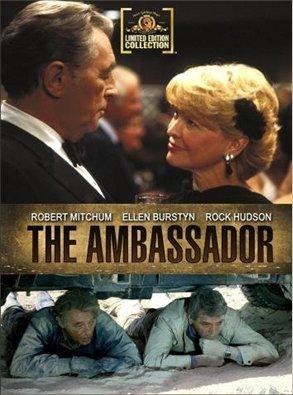
On DVD: The Ambassador (MGM Limited Edition Collection)

The Ambassador is a lot of ridiculous fun with a bizarre combination of elements, including a very 1980s thriller milieu involving middle eastern political strife and terrorism, a 1930s pulp adventure plot, and two major stars of yesteryear - Robert Mitchum and Rock Hudson (his last film) - being directed by the capable and prolific J. Lee Thompson. Throw in good supporting performances by Oscar-winner Ellen Burstyn and former Blofeld Donald Pleasance, and you have an entertaining (and somewhat campy) action picture that's hiding a few interesting surprises.

The film opens with United States ambassador to Isreal Peter Hacker (Mitchum) and his security aide Frank Stevenson (Hudson) traveling out into the Judean desert to secretly meet with representatives of the PLO. The meeting is broken up when the group is attacked simultaneously by the Israeli secret service and members of a radical PLO splinter group; each of these groups first attacks the rendezvous and then each other. It's a chaotic batshit sequence that confuses the participants amid decent aerial camerawork and rapid-fire gunplay.

Meanwhile, Hacker's wife Alex (Burstyn) is involved in an affair with an antiquities merchant who turns out to have ties to the PLO. The same splinter group that attacked Hacker's desert meet with the PLO is tracking Alex's movements and films her illicit trysts, using the footage to blackmail Hacker into desisting from his attempts at diplomacy among the various interested parties. (I would be remiss if I did not at least mention the, uh, two surprises that Burstyn - aged 52 at the time of the film's production - provides in these early scenes.)

As far as the story goes, it's a pulpy mess of cliches and easy action-film tropes. But the cast keeps things interesting, especially the odd dynamic between Mitchum and Burstyn's characters. These middle-aged globe-trotting bureaucrats don't have much of a marriage, and when Burstyn's affair is revealed, Mitchum's response is more empathetic than angry. The situation ends up bringing them closer together. I don't know how realistic this scenario is, but the actors bring it off well, sharing a world-weary closeness that grows interestingly as the film goes on.

Other aspects of the film are muddled at best - particularly the conclusion, which features gathering of students from both sides of the Israeli-Palestinian conflict, who have convened at Hacker's behest to talk peacefully about a way forward. They wind up being massacred by the machine guns of the PLO splinter group in a violent sequence that eerily prefigures (at least in some respects) the 1987 Mecca massacre. It's a bloody scene that, like much of the film in general, doesn't accomplish much dramatically while maintaining the highest standard of sensationalism. Still, The Ambassador is weird, choppy fun that is maintained by a cast of legendary Hollywood stars. 

6.06.2011

On DVD: The Boy Friend (Warner Archive Collection)

The Boy Friend is equal parts throwback and time capsule - an homage to the great Warner Brothers musicals of the 1930s choreographed by the legendary Busby Berkeley, and a record of an era in filmmaking (1971 to be precise) that fostered experimentation beyond the traditions of the Golden Age studio system - even at major studios such as Warner Brothers, which financed and distributed Ken Russell's adaptation of Sandy Wilson's smash Broadway musical. 

Twiggy, fashion icon of the 1960s, stars as Polly, the assistant stage manager at a second-rate theater in an English seaside town. The troupe is in the midst of its run of "The Boy Friend," except that it is short its leading lady, who has recently been injured. So, Polly is thrown in as a last-minute replacement by the troupe's ambitious director (Max Adrian), out to impress the visiting Hollywood director De Thrill. The performance goes on, with Polly gamely struggling to keep up and ultimately stealing the show by virtue of sheer unpracticed charm. Her convincing performance is aided immeasurably by her real crush on the male lead, Tony (Christopher Gable), whose level of reciprocation appears to be ambivalent throughout. 

Russell's conception of the whole is as a play-within-a-movie, an old-fashioned Hollywood musical with fantasy-like dance numbers that extend well beyond the world of the film's setting. In sequences that rhapsodically depart from the creaky stage of the troupe's run-down theater, dancers perform as dice, as the characters on playing cards, as mushroom-dwelling forest gnomes, as Classical libertines, and as bits of kaleidoscopic glass that move upon gigantic revolving turntables. These numbers are made whole thanks to show-stopping music (Wilson's score was ably adapted and supplemented by Peter Maxwell Davies) and infectious, energetic choreography and dancing. The Boy Friend is easily the best Busby Berkeley musical that Berkeley never made.

Taking their cue from silent cinema as well as Hollywood musicals of yore, the cast hams it up appropriately. Gable is toothy and a touch too pretty as Tony. Adrian is anxious and greasy as the director Max. Glenda Jackson appears in a wonderfully modulated cameo as the injured leading lady, letting Polly know she'll never measure up, only to follow that with restrained encouragement. Tommy Tune has a featured role as a predictably dance-savvy cast member. As Polly, Twiggy embodies some of the same qualities that made her so influential in fashion - quiet humility, innocence, and easy, effortless charm - something like a female Oliver Twist. 

Russell is known as an excessive director, and although The Boy Friend is never excessive in its content, it is rather long. I suspect a judicious editor could easily shed 20 or more of the movie's 138 minutes and not harm the film's narrative flow or spectacular dance sequences. Still, that is the only real caveat I can think of. The Boy Friend is old-fashioned filmmaking that captures a classic feel while pushing the cinematic form of the musical forward in ways that still look clever forty years later. 

Read the full review here

5.27.2011

In Theaters: The Tree of Life


I'm still processing The Tree of Life - still turning over its many ingredients, layers, and moments. The fact that it's been two weeks since the screening and my brain is still stewing means that the film is special and unusual. Yet I don't think I wholly enjoyed Terrence Malick's Palm d'Or-winning sixth feature.

The Tree of Life is everything and nothing - a moving masterpiece and a magisterial mess, gloppy with pretension yet riddled with some of the most jarring and memorable imagery ever committed to film. Good performances and bad dialogue live side by side in Terrence Malick's sixth and most maddening film, as do profound beauty and incoherent editorial choices. The crux of the movie's soulful confusion is that it is both a visionary cosmic statement and an apologia for suburban averageness. The overarching concept here - that religious meaning and spiritual enlightenment can be found on the most unlikely and unexpected city block - is not new, nor is it alien to depiction on film. But the details are divided into two prongs - one that is dramatic and specific, and another that is abstract and impressionistic. In the case of The Tree of Life, this bifurcation is hampered by excessive cutting and, ultimately, a glut of imagery that, despite its high quality, results in a sense of visual over-stimulation and a muddying of the film's thematic waters. Malick's ambition is rare and impressive. But his editorial eye continues to suffer from benign but distracting spasms.

The Tree of Life is a mosaic. Its non-linear narrative is spiked with sequences that somewhat abstractly depict the formation of the solar system and the beginnings of life on earth. The narrative portion of the film (which accounts for the majority of its screen time) concerns the lives of a five-person nuclear family, the O'Briens, who live in the suburbs of west Texas. The close-knit family consists of Mom (Jessica Chastain), Dad (Brad Pitt), and three young boys. The oldest, Jack (Hunter McCracken), is the key figure in the film. A troubled boy, Jack is torn by his love of his parents - the unconditional kind for his mother, and a conflicted love/hate for his domineering but affectionate father.

Pitt's performance is outstanding. His role is wide-ranging and emotional, and the actor brings an authentic sense of character and period to the part. It is a performance of incredible depth and breadth, truly one of the best from any leading Hollywood star in some time. As Mom, Chastain is the object of her son's love and worship - and at the same time a second-class citizen in terms of her dynamic with Pitt's character. Put-upon, and occasionally abused by her husband, Chastain is physically vulnerable and morally inviolate. Pitt's character is very much the opposite - a pillar of physical strength with an occasionally expedient attitude toward morality.

Malick indulges in two of his favorite cinematic devices: a reliance on vague, lyrical voice-over to solidify the film's themes, and a preference for classical music on the soundtrack. Malick's other films, I think, benefit from these devices, whereas The Tree of Life does not. The film's striking imagery and subtle themes don't require the storytelling crutch of narration to sustain them. In fact, the voice-over is distracting rather than additive. On the subject of music, Malick has a well-known knack for nimbly inserting classical pieces in his films that help create an immediate mood and connection to the story: Days of Heaven uses Saint-Saëns' "Aquarium" from The Carnival of the Animals to beautiful and creepy effect, and the opening of The New World features the "Vorspiel" from Wagner's Das Rheingold as the spine-tingling sound of the first meeting between the English and Native Americans. The Tree of Life, on the other hand, feels as if it is cut to the musical selections. At times, there is a feeling that Malick is more interested in creating mini-films around the music than in making a cohesive larger work.

I say that because, in the end, The Tree of Life is not cohesive. It not feel complete. It feels like it is missing pieces here and there, and it feels redundant in other areas. We spend too long milling around in outer space and in the oceans of the early Earth. We spend too long in the O'Brien household, watching the same sets of family dynamics play out over and over again. That Terrence Malick has made a messy film is not a surprise or a disappointment, for Malick's last three films plainly flirt with disaster - they are chunky, disordered, and unpredictable. But The Tree of Life misses the mark because Malick does not seem to have gone far enough in terms of the film's conception: the cosmic inferno and the scenes of early animal life are memorable, but those sequences do not sufficiently interact with the common travails of a single and seemingly isolated family in 1950s west Texas, despite the fact that I enjoyed watching most of what was on the screen - especially the dinosaurs.

5.18.2011

On DVD: Deep Red


Deep Red might the most beautifully shot horror film ever made. The whole movie floats amid an array of rich color, sweeping camera movements, and lovingly designed sets that recall scenes from the devil's version of the Golden Age of Hollywood. Deep Red is hardly the only film by Dario Argento to share these qualities, but it might be the most confident and seamlessly executed. For all his visual gifts, Argento's films often suffer from uncomfortable editorial quirks and overly-jarring musical stings - things that take us out of an otherwise hermetic environment that only a visual perfectionist could have created. But Deep Red captivates from frame one, and I was never jostled out of the film's world by technical imperfections. The mood is consistently engaging, and although as a horror film it's not a terribly horrifying one, Argento's standard obsessions - innocent heroes, faceless sources of terror, washes of light, and, of course, flesh being stabbed and slashed by sharp things - are on full display.


A woman who claims to have extrasensory abilities is murdered in her apartment in Rome, while her neighbor, pianist Marcus Daly (David Hemmings), witnesses the attack from the street below. He proceeds to investigate the murder with the help of his gay friend Carlo (Gabriele Lavia) and a reporter named Gianna (Daria Nicolodi). Clues pile up - a creepy children's song, a missing painting from the dead psychic's apartment - leading Marcus to an old mansion that holds the key to the killer's identity and motive.


Hemmings is a brilliant casting choice. The heartless photographer turned tenacious detective from Blow-Up is re-cast here as an over-his-head musician with no aptitude for the supernatural - or for the rigors of a dangerous investigation, for that matter. Hemmings has the blank-faced intensity of the single-minded and, although he was famously accused by the Monty Python gang of being "a block of wood," his performance here is appropriately unflashy. But Marcus is driven - obsessed, even, by some of the same ideas with which Argento himself is preoccupied.


A telling - and very funny - scene in which Marcus angrily challenges Gianna to an arm-wrestling match tweaks the nose of the very English interest in following sets of pre-established rules at the same time that it reveals something about Argento's view of women and perhaps something about his proclivity for stories with female protagonists. Another regular Argento theme that runs through Deep Red is the notion of children and adolescents who witness something horrific at an impressionable age and the damage that it does to them over time - an idea present in Suspiria and others, but which relates directly to Deep Red's climax.


Argento's penchant for irregular pacing is not as evident in Deep Red, with the story unfolding at a relatively consistent rate, with set pieces spaced evenly - and, importantly, with enough exposition in between so that the plot feels cohesive. That is to say, Deep Red is more conventional in form than some of Argento's other films - for better or worse, it lacks that dream-state sensation that Argento excels at. The movie is generally rooted to its story. We never feel like we are floating away from it into a netherrealm only to learn that the story really never mattered in the first place. As such, Deep Red might make a good introduction to those who are new to the director's work. 


Whatever one's assessment of the plot, which by itself is not particularly unique, Deep Red succeeds because of its visual accomplishments. Argento creates an alternate Rome where everyone speaks English - well, it's not Rome at all, really, but a bizarre Anglo-pean hybrid movieworld where things work as they do because Argento wants them to. But we see beyond the contrivances because Argento's vision is so unique and his imagery so memorable and convincing.

Read the full review here

On DVD: Cop Hater (MGM Limited Edition Collection)


The clingy heat of a New York summer hovers over the characters in Cop Hater with the same oppressive quality as the paranoia that grips their Manhattan precinct as a killer stalks its officers. Adapted by producer-director William Berke - an extraordinarily prolific and largely forgotten specialist in low-budget quickies - this B-grade adaptation of Ed McBain's first novel of the 87th Precinct (a series that would span dozens of volumes over nearly half a century) succeeds thanks to good performances and the authenticity of its setting.


Robert Loggia plays Steve Carelli, a detective investigating a series of cop murders with his partner Mike Maguire (Gerald S. O'Loughlin). With few leads, the pressure mounts as the killings continue. Carelli and Maguire's case - and their information - is pursued by a tenacious reporter (Gene Miller), who winds up indirectly endangering Carelli's deaf-mute bride-to-be (Ellen Parker). 


Unambitious visual choices and pragmatic editing allow Berke to zero in on maintaining suspense and staying true to McBain's characters. The cramped precinct rooms are sweaty with summer heat and the palpable, top-down pressure applied by police superiors on the detectives working the case - in addition to that applied by their fellow cops, who are ravenous for justice as their own continue to be hunted down on city streets.


But Berke was also plainly interested in the exploitative aspects of filmmaking, and knew that sex and violence sells tickets. There are a handful of scenes that might not have made it past the censors in 1958 had this been a major studio picture (it was released theatrically by UA). These include a sequence involving Carelli's fiancée emerging from a shower and being threatened with rape. Additionally, there are a handful of moderately racy moments provided by Shirley Ballard as Maguire's aloof glam-queen wife.


Loggia is excellent, exuding great if restrained charisma as Carelli. The supporting actors are all fine, with O'Loughlin particularly convincing as a weary blue-collar kind of guy (if anything, Loggia is almost too handsome for the role). Keep an eye out for terrific early appearances by Jerry Orbach as a street tough, and Vincent Gardenia as a hopheaded informant. 

Read the full review here

On DVD: Soldier in the Rain (Warner Archive Collection)


Steve McQueen was not a good comedian, and I've always thought Jackie Gleason was more threatening than funny. They were co-billed as the stars of 1963's Solider in the Rain, the title of which certainly doesn't evoke smiles. Nonetheless, it is a comedy, with a screenplay by Maurice Richlin and Blake Edwards from an early novel by William Goldman. The movie struggles against low production values and pat TV-friendly material that doesn't invite either actor to inhabit their characters beyond the level of overly-familiar types.


McQueen is supply Sergeant Eustis Clay, a happy-go-lucky schemer in league with Master Sergeant Maxwell Slaughter (Gleason). Slaughter lives the good life in his well-appointed peacetime office, thanks in part to the machinations of Clay, who helps Slaughter gain access to the newest and most sought-after goods coming through the base. Slaughter is a career officer, but Clay, who can hardly wait to get out of the Army, tries to lure the older man into civilian life so they can go into business together. Slaughter regularly extracts Clay from one jam or another, and in return, Clay sets Slaughter up with a blonde chippy less than half his age named Bobbi Jo Pepperdine (Tuesday Weld). However, the next time Slaughter comes to Clay's rescue, it has unexpected consequences that lead to the film's rather mawkish conclusion.


Tone is a problem in Soldier in the Rain, which has dramatic pretensions that come off as forced. But the "comedy" is problematic, too. The movie just isn't funny. Gleason has a handful of decent moments, but I keep thinking he's going to hit someone - which is ridiculous, because the character he is playing is a sweetheart. McQueen is horrible - mugging idiotically and putting on a completely made-up "hick" accent. He plays Eustis Clay as a "dimwit," but for those of us paying attention, Clay isn't actually that dim as written - so what's with McQueen's performance? Watching Soldier in the Rain has made me re-assess other McQueen roles - roles that I've never bothered giving much thought - and I'm realizing that there may be a gross falseness to everything the actor ever did. Even worse, however, is Tony Bill who, as the resident goofball, tries to channel Jerry Lewis and fails spectacularly.


Soldier in the Rain could have been a funny, acerbic take on the complacency of the US Army in the 1950s and 1960s - on the ridiculous wastefulness of the biggest and best-armed military force in the history of the world, its men and women spending their days daydreaming and cooking up prison-like schemes to trade surplus mattresses for electric fans. But satirical angles are wholly ignored; in fact, the movie takes time out to honor the military establishment. There's nothing wrong with that, except that there's nothing very honorable about the film's characters. They are layabouts and scatterbrains, and they would have been more at home in a military satire as opposed to a straight comedy.

Director Ralph Nelson adds nothing visual to the film, shooting it as one might a live television play. The plot moves along quickly enough (the movie only runs 87 minutes), but there are no ups or downs - the story and tone are flat to the extent that scenes become indistinguishable from one another in the memory. 

Read the full review here

5.14.2011

On DVD: The Great Scout and Cathouse Thursday


The Great Scout and Cathouse Thursday is an Only in the '70s kind of experience, from the elongated title down to the crappy film stock on which it was shot. A ribald, anarchic comedy that wants to be more edge and politically savvy than it actually is, the movie is ultimately let down by a lack of imagination at the conceptual level and the blind eye that director Don Taylor casts over matters visual.


The "great scout" of the title is Sam Longwood (Lee Marvin), a former Army scout and now a has-been frontiersman. He and his half-breed partner Joe Knox (Oliver Reed), are out to recover money stolen from them by former mining colleague (and current rail magnate and gubernatorial candidate) Jack Colby (Robert Culp). A chance encounter between the old partners spurs Longwood and Knox to chase Colby across the West as Colby stumps for presidential candidate William Howard Taft. Along for the ride are a disenchanted young prostitute known as Thursday (Kay Lenz) and filthy old souse Billy (Strother Martin).


Great Scout's screenplay, by Richard Shapiro, strives to embrace the radically shifting racial and sexual politics that were dominant in the 1970s, but can't quite keep up. Reed does manage to have a lot of fun with the character of the half-breed, Knox, handling him as a kind of split personality - an educated white man with traditional values that conflict with a delusional self-identification as a wild Indian given to scalping and rape - although he has never done either. It's a well-written role that addresses the schizophrenic, bifurcated white perception of Native Americans as exemplified by the idea of the "noble savage."


Beyond the character of Knox, the script stumbles on other important points, particularly in the areas of pacing and jokes. Great Scout is a slow film that resorts to truly ridiculous slapstick to get itself out of narrative jams. An early cameo appearance by a fire hose gives us a taste of things to come.

Sadly, the movie is unable to provide its terrific cast with enough to do. Marvin is wasted, reduced to pratfalls. Lenz looks cute but is forced to whine and flail helplessly about. Strother Martin plays a one-note lecher. There are "jokes" about rape (another Only in the '70s ingredient). There are "jokes" about scalping. There are "jokes" about lesbianism. They're not necessarily offensive - although some might say otherwise. Mainly, they just aren't funny.


On top of this mucky stew of undeveloped characters and situations is a dreary layer of visual gruel that reflects a total lack of interest in the western United States of the 1900s. The sets and costumes look like leftovers from Petticoat Junction. The buildings look like they could be easily collapsed at the end of the day and stored in a warehouse someplace. There's not a shot in the movie that looks like anyone made a single step toward any kind of authenticity - even if that authenticity is just based on visual cohesion. Visually, the movie is a zero. 

Read the full review here

4.15.2011

In Theaters: The Conspirator


As an actor, producer, and director, Robert Redford's contribution to film is marked by close, thoughtful preparation, detailed pre-production, and polished execution. Although no one's filmography is flop-free, Redford's best films are marked by tight scripts, excellent casting, and a shot-by-shot flow that suggests precise storyboarding and pre-visualization. On The Conspirator, Redford serves as director and one of eight credited producers, and the surprise of the film is its sloppiness and the feeling that the entire project was rushed through production. The Conspirator suffers from an underdeveloped script, miscasting, and a perfunctory visual style. Nothing about the film suggests the involvement of Robert Redford - or any director with decent narrative sense or a judicious eye. The Conspirator is a flavorless political statement in the guise of a historical drama. It could have been directed by anyone - or, for that matter, by a committee of dullards.

The Conspirator's fact-based plot couldn't be more promising as the basis for a riveting film: Following an opening sequence that shows the assassination of President Lincoln at Ford's Theater, along with the attempted murder of Secretary of State Seward and Vice President Johnson, the film tells the story of Frederick Aiken (James McAvoy), a Civil War veteran and lawyer newly employed by Senator Reverdy Johnson of Maryland (Tom Wilkinson). Johnson arranges the defense of the conspirators who plotted Lincoln's assassination, one of whom is a woman, Mary Surratt (Robin Wright). Surratt owned a boarding house where the conspirators were known to have met, but her role in the conspiracy itself is hazy at best. Johnson tasks the reluctant Aiken with defending Surratt, who proves to be an opaque figure that refuses to readily explicate the nature of her role and her relationship to the conspirators. Aiken encounters further opacity in the form of the politically-expedient but extra-legal military tribunal that tries the conspirators, a body of men who are there not to analyze but to condemn. They serve at the pleasure of Secretary of War Edwin Stanton (Kevin Kline), who wants to punish the accused to help heal the nation's grief.

The Conspirator feels like a made-for-TV quickie with a larger budget. Its narrative is rushed, first and foremost. Every scene feels hurried and false, as though a large story has been assigned to a narrow time-slot, forcing arbitrary last-minute shortcuts. We are hustled through an un-thrilling depiction of the assassination, which sets up the film's dramatic situation. Surratt's quandary is established not with a sense of historicity, but with the dry tone that usually accompanies a finger-wagging lesson being impressed upon a naive or naughty audience. The parallels between the incidents portrayed in The Conspirator are too close to events occurring in our own era. That doesn't mean that they don't bear examination; it means that a film based upon those incidents is going to have to fight not to look cheesy, forced, and obvious. The Conspirator doesn't fight hard enough.

Although he's the protagonist, we don't know much about Aiken's interior life - even though, during the film, he undergoes a serious intellectual and moral challenge. He is a Civil War veteran who desperately wants to see the conspirators punished, and at first he unquestioningly assumes Surratt's guilt. Despite a deep desire to see her hang with the rest, Aiken begins to suspect that the trial is not Constitutional. Yet we don't know what he's thinking or feeling, especially regarding the transition he experiences. I don't think this is McAvoy's fault, although I will say that his entire performance seems cribbed from the Tom Cruise Playbook of Mannerism and Line Reading. It's the script's fault. It's unacceptable that a highly conflicted protagonist should remain so veiled, when his thought process and emotional experience is really what the film wants to be about. Other characters are given more careful exploration, both by the script and by the actors who portray them, particularly Surratt, whose screen time and dialogue is relatively minimal, but whose presence, in the form of Wright, is dominant.

But the movie is too bogged down in earnest political philosophizing to ever become a truly character-driven drama. The movie's argument is clear within its first half-hour: military tribunals thwart the rights of US citizens. As post-9/11 Americans, we are familiar with this argument and the issues that surround it. The parallels are obvious. A feature film that deals with political topics has the opportunity to play out ideas in a dramatic fashion, illustrating abstractions and principles in terms of human lives and relationships. But The Conspirator doesn't go past the level of chat show talking points: military tribunals are wrong; Surratt may have been wrongly executed; Aiken was transformed by his realization that Constitutional rights belong to every citizen. These concepts are easily summarized, as I have just done. It doesn't take a movie to explicate them.


4.11.2011

On DVD: Inferno


Dario Argento is a filmmaker whose work is easy to appreciate but difficult to love. He is easy to appreciate because his movies are the product of a specific vision and a unique, influential aesthetic. Argento's neon-lit sets and moody, Lovecraft-infused plots have atmosphere to spare. Yet he is difficult to love because his brand of horror, although suspenseful and engaging, is devoid of emotional content. His characters are often types - innocent virginal women and naïve, confused men - cast merely as the vulnerable targets of evil predators. There is little psychology or personality driving Argento's films - other than the director's own. 

Inferno starts out strongly, with a voice intoning the mythological premise of an ancient book known as "The Three Mothers." We learn that three evil sisters secretly rule the world from lairs constructed specifically to harness their special powers. In New York, Rose (Irene Miracle) discovers that she may be living in one of these lairs - an old Gothic apartment building. She sends a letter to alert her brother Mark (Leigh McCloskey), a music student living in Rome. The letter finds its way into the hands of Mark's classmate Sara (Eleonora Giorgi), which in turn brings her to a tragic fate. Mark finds his way back to New York, but is too late to help his sister, who has already been found by the evil forces she has accidentally unleashed.


As an exercise in style, Inferno has a hermetic perfection about it. The visual method is characterized by large swathes of color (washes of light, spans of empty wall space, unusually large doors and windows) and graceful camera movements that always maintain compositional integrity. Argento creates his own visual grammar.


But Argento is somewhat undone by the characters he creates - one-dimensional types who don't have inner lives to speak of, nor are we ever certain that they have much comprehension of what is happening to and around them. This makes it difficult to empathize with them. If characters on-screen have some grasp of the plot (even when we don't), this makes it easy to forgive plot holes. We follow stories based on characters' experiences. It's never very clear that Rose or Mark understand that evil has been let loose in their world - and that might be acceptable if we knew that they know or don't know. Inferno leaves its characters in the lurch, however, without establishing clarity as to the protagonists' relationship to the horror they face. And this causes the film to lose momentum in its second half.


It's a shame that Inferno isn't strong enough to deliver on its many interesting ideas. Ultimately, a film's ideas need to be enshrined somewhere concrete within the film - and most often that place is within its characters. But Argento relies too heavily on visual technique, which, while impressive and often arresting, can't undo the awkwardness of characters who have been abandoned at the film's center. 

Read the full review here

On DVD: The Tourist


The Tourist is beautifully shot by the accomplished Oscar-winner John Seale. It captures classically romantic locations like Paris and Venice with a visual caress lacking in Hollywood productions for some time. The look of the film reminds us not so much of the gritty Bourne series as much as David Lean's Summertime and Stanley Donen's Charade. Unfortunately, the comparisons end there. As much as The Tourist attempts to capture not just the look but the tone of those and other jet-setting comic thrillers of the past, it fails to generate tension or laughs. In fact, the picture is just another big-budget dud of the type we have come to expect from studio tent pole projects these days.

The freakish Angelina Jolie - who I'm certain will later be remembered as a sort of female Victor Mature, with her exaggerated, artificial good looks - plays Elise Ward, a mysterious Englishwoman being pursued by a number of international police agencies, all of whom are hoping she will lead them to the shadowy master criminal Alexander Pearce. On a train to Venice, she selects Frank (Johnny Depp) as a decoy for Pearce, and takes him along on her jaunt across Europe. A series of twists and turns allow the leads to have some fun with power-play reversals - and then all of a sudden we're supposed to believe that romance is blooming between the two. The rest of the film is a leaden chase, stunted by the leads coming off as virtual ciphers with no emotional lives or explicit goals.

The Tourist is a big mess with high production values. The fact that it is visually successful proves that the film was better-prepared than the shoddy, misshapen script would suggest. It had to have been thoroughly storyboarded. Yet the script, credited to director Florian Henckel von Donnersmarck as well as Oscar-winners Christopher McQuarrie and Julian Fellowes (and based on the well-reviewed but little-seen French film Anthony Zimmer from 2005), tries too hard to capture a classy retro mood and scenario rather than reaching for a clear notion of its leading characters. And even that fussed-over scenario lacks credibility. An early scene in which a Scotland Yard investigator pieces together bits of a note Ward had burned to a crisp is handled with a ridiculous observational straightforwardness, instead of being the comical take on spycraft it could have been. Whether or not the technology exists, its portrayal lacks all plausibility. Also, it's worth pointing out that the chief reason Pearce is being pursued by so many different agencies is because he owes the British government back taxes!


Jolie is like a Jordan almond. You think this nice-looking candy treat is going to be sweet and delicious, but really it's just weird idea that turns out to be bland. Depp continues his pursuit of projects that provide overexposure without the balancing benefit of furthering his range of characterizations - or utilizing his talent at all, for that matter. Both actors are charisma-free in The Tourist. The movie's lush production values, in addition to allowing DP Seale to capture some of the most iconic vistas in Europe, affords an engaging score by James Newton Howard. In all other respects, The Tourist is a shamefully expensive wreck of a movie. 

Read the full review here

3.30.2011

On DVD: Who's the Caboose?


Who's the Caboose? is a small film from the late 1990s that would seem to prove the argument that true talent will find a way. Dating from 1997, Who's the Caboose? was co-written and directed by Sam Seder, who has gone on to success as an actor and radio and television host. It stars Sarah Silverman, and features appearances by Andy Dick, David Cross, H. Jon Benjamin, Kathy Griffin, Laura Kightlinger, and Marc Maron. It is a funny, improv-driven film that also serves as a portrait of the comedy scenes in both New York and Los Angeles at the time of its production.

Susan (Silverman) is a comedian who decides to leave New York and travel to Los Angeles for pilot season. Pilot season (approximately April - June) is when studios cast for the new shows scheduled to air that fall. Susan doesn't tell her "performance artist" boyfriend Max (Seder) until the last minute, but he follows her out to LA anyway, despite a proclaimed disdain for that city. Susan becomes busy trying out for shows, under the tutelage of her airheaded manager Jason (Andy Dick) and his put-upon assistant (Lauren Dombrowski). Before he knows it - and without intending to - Max has drawn the attention of an ambitious entertainment attorney named Ken Fold (Benjamin), who could not be more enthusiastic about turning Max into a star.

The best thing about
Who's the Caboose? is that it is not dramatically or thematically ambitious. This leaves the actors free to explore their parts and their environments realistically, drawing humor from casual interaction and mundane situations. The movie is about the years of struggle that every artist must endure, sleeping on couches, battling entertainment fringe figures who want to shape and mold you into their own visions of success, and getting by on scant wages. It's also about the moral and social freak show that is Los Angeles and the bizarre priorities of people who are drawn there for one reason or another. Not dated at all fourteen years after its original release, Who's the Caboose? remains fresh, honest, and very funny. 

Read the full review here

On DVD: Kings of Pastry


Kings of Pastry is a truly thrilling and informative look at the somewhat secretive and incestuous world of French patisserie - specifically, the pastry- and candy-making portion of the quadrennial Meilleur Ouvrier de France (MOF) competition among craftsmen in various disciplines. Acclaimed filmmakers D.A. Pennebaker and Chris Hegedus (Don't Look Back, The War Room) follow three competitors as they prepare and compete in this high-pressure contest whose winners will forever hold the highest distinction in their field.

The film highlights Jacquy Pfeiffer, a French-born but Chicago-based pastry chef, who has a great emotional and professional investment in the competition (although this could easily be said of every other competitor, too). Jacquy has an American girlfriend and daughters, and must leave his adopted home for several weeks to practice prior to the MOF. We also meet Philippe Rigollot, a candy specialist whose work is inspired by his own children, and the somewhat blasé Regis Lazard, who is perhaps the least intensely motivated of the three.

The parameters of the competition are roughly as follows: Over a period of three days, sixteen contestants share kitchen space as they prepare approximately forty recipes of varying degrees of complexity. They include lollipops, chocolate candies, small cakes and tarts, a wedding cake, a large-scale dessert "sculpture," and a decorative piece entirely of sugar called a
bijou ("jewel"). Each of these concoctions is judged by a dozen or so prior MOF laureates, who turn them over in their mouths assessing the balance of ingredients, weight, texture, and of course flavor. Each chef has already prepared his (there are no female competitors) individual recipes for each item in advance; each day's activities are timed.

Pennebaker and Hegedus have captured real toil and drama in this story of obsessive, driven creative individuals. The many potential hazards of baking are addressed, including the quality of ingredients, timing, and atmospheric conditions. The fragility of the different pieces - especially the sugar sculptures - is an ongoing source of tension.


It's unfortunate that the visual style of the film doesn't complement the beauty of the MOFs' creations. It's shot in a particularly unattractive digital format that leaves the film looking less polished than a local news broadcast. Given the extraordinary filmography of the directors, the clumsiness of the presentation came as a surprise.


On balance, however,
Kings of Pastry is a fitting tribute to men of rare talent. It's an engrossing look at a rarefied and largely unknown world.

Read the full review here

3.04.2011

On DVD: 127 Hours


127 Hours has a true-life plot that would have appealed to Antonioni, but the film is shot through with hyperkinetic visuals that recall Oliver Stone in the 1990s and director Danny Boyle's own hit, Trainspotting. Although the content and the form don't always interact happily, James Franco gives an energetic and layered performance as Aron Ralston, an amateur outdoorsman and rock climber who, in 2003, became trapped in a Utah canyon when a boulder came loose and pinned his right arm to the rock wall.

Boyle and co-writer Simon Beaufoy had a number of challenges before them in selecting Ralston's story as a film project - in fact, it almost looks as though they specifically chose the story for its seeming plethora of anti-cinematic qualities. One thing they had working against them was the broad media saturation of Ralston's story. At least in the United States, virtually everyone with functioning senses had learned of Ralston and the broad outlines of his story within days of his escape. Another factor that would have made many other filmmakers turn away from Ralston as a feature subject is the relative simplicity of his tale. Ralston went out into the wilderness alone, became trapped for five days, and finally cut off his own arm to make a successful escape. Beyond those bare facts, there is not much incident and only a very few supporting characters.

Boyle and Beaufoy's success in 127 Hours is in crafting the film's story as a running expression of Ralston's mental and emotional state, his perceptions, his daydreams, and his memories. Wherever Ralston's thoughts go - whether backward into memory, forward into desire and premonition, or rooted in the dire present - the film follows swiftly and surely. The filmmakers are aided immeasurably by Franco's deft, fluid performance. He plays Ralston with a goofy, dorky energy in the film's opening segment, but that modest cockiness gives way to a transcendent sense of his own isolated smallness as doom seems to close in. Somewhere within that isolation Ralston found a force of will that shattered his transitory terror to smithereens. The flux of Ralston's state of mind is the film's - and Franco's - triumph.

But within this effective storytelling approach, Boyle too often reaches for stylistic flourishes that take away from the simple, stark, powerful idea that holds the whole thing together. The camera is too active. Cutting is too rapid and flashy, with an annoying panoply of optical and other effects taking away from the human struggle at the film's center. Although narrative devices such as flashback, dreams, and visions are deftly executed, other visual tricks - including a rather repetitive Fincheresque dependence upon being inside of things such as Ralston's water bottle, camera, and even his doomed arm (!) - are distracting and subtractive instead of additive.

The penultimate sequence involving the fate of Ralston's right arm is as tooth-gnashing as one might imagine, but it is also assembled in a way that avoids unnecessary graphic detail. The deed is indeed carried out with a determination and force of will that never once appears desperate. We see Ralston toy with the idea of severing his arm earlier in the film - both he and we know what has to come. (Despite the relative restraint of this sequence, the person I watched the movie with - and who declines to be identified - wound up tossing her cookies anyway.) 

Read the full review here

2.15.2011

On DVD: Get Low


Robert Duvall has been playing spirited old men for more than twenty years, and now pushing eighty, Duvall has found what might be the best of these roles in Felix Bush, the protagonist of Aaron Schneider's directorial debut, Get Low. Throughout his varied career as an actor and filmmaker, Duvall has established himself as a prolific, professional, committed, and always compelling presence, performing in a strong mixture of big-budget Hollywood movies and tiny independent films - although his contributions to smaller films usually guarantee an automatic enlargement of sorts. Whatever the project's scale, Duvall can be depended upon to provide some combination of down-to-earth sincerity, genuine heart, and, occasionally, an unpredictable ferocity. Get Low is a showcase for Duvall, and the character of Felix Bush is layered in way that allows the actor to explore an uncommonly broad portion of his range.

Get Low opens with Felix Bush chasing children off his property - a grizzled, bearded, ancient old coot living out in the middle of nowhere in a tiny cabin with a small adjacent barn. It's the early 1930s, or thereabouts, and the surrounding town has buzzed with rumors about Felix for several decades - that he's a killer and a beast, and who knows what else. One day, Felix makes his way into town for a meeting with the undertaker, Frank Quinn (Bill Murray) and his associate Buddy Robinson (Lucas Black), and requests that they "make him a funeral party" - at which Felix himself plans to be present. The idea is that all the townsfolk - in fact, all the residents of the nearest four or five counties - will be invited to attend and tell a story about Felix. For this service, Bush promises Quinn a healthy sum. And, to promote the event, Felix offers the bequest of his land, to be awarded by lottery at the "funeral."

The plot turns mostly on Felix's motivations for hosting this bizarre event, which have to do with the reason he's been hiding out in the woods by himself for four decades. When an old flame returns to town (played by Sissy Spacek), things become more complicated.

Get Low is anchored by its uniformly outstanding cast, starting with the powerhouse performance by Duvall in the lead. His Felix is a mysterious, withdrawn manipulator who is also likable, temperamental, and masochistic. Duvall tackles the job with great energy, applying his enormous talent to a role that dominates the picture without a whole lot of dialogue - Bush is a man who uses exactly as many words as he needs to and never repeats himself. Duvall conveys this through an aged confidence and his usual mannerisms: licking his lips, pressing on his chest with his hands, and making bizarre wind-like noises - all of which continue to work wonderfully.

But Duvall's is hardly the lone performance of interest. As Quinn, Murray is perfectly cast. Quinn is a failed salesman from Chicago, who has recently remade himself as an undertaker in this small Southern town. He drinks, dresses flashily, and sports a pencil moustache - all of which contribute to his fish-out-water demeanor. Murray invests Quinn with an urban opportunism that is slowly but surely foiled by Felix's odd combination of decency and determination. As always, Murray is appealing and funny as this would-be shyster who finds himself baffled into honesty. Quinn's assistant, Buddy, is played by Lucas Black as a conservative, earnest young man in whom grows a real affection for the oddball Bush. And the formidable Sissy Spacek is affecting as Felix's one-time lover, who finds herself jilted all over again under a new set of circumstances.

Seasoned cinematographer Aaron Schneider brings a sensitive eye to his directorial debut, which is photographed beautifully by David Boyd. There is a point in the last third of the film where the storytelling becomes confused - almost beyond repair. The solid script by Chris Provenzano and C. Gaby Mitchell is patient, allowing its characters to evolve and change in interesting, subtle ways - and in this respect, the script is a gift to the film's actors. But in its last third, some strange, seemingly arbitrary things occur that are without precedent - and the film's resolution, while generally sound, is pushed a little off-balance by this handful of scenes. In the interest of avoiding spoilers, I will just say that Bush says and does a couple of things that I felt were out of character, and his motivations begin to feel less consistent than they were up to that point. I also have a couple of reservations about the actual funeral sequence, which, despite its prolonged set-up, doesn't include a single "tall tale" from party guests.

Read the full review here

1.27.2011

In Theaters: Biutiful


I walked out of Biutiful, so take this review with an appropriate measure of skepticism. I haven't walked out of a movie in years, but Biutiful seemed to be daring me to leave within its first twenty minutes. Despite an arresting pair of opening moments, Biutiful devolves into a sluggish, meandering, dour assemblage of scenes that are utterly - shockingly - without momentum. At two-and-a-half hours, Biutiful is not the longest of movies, but after nearly half of that length, I felt like I'd spent a whole day in the theater without getting anywhere. I could not stand to spend another minute in the presence of co-writer and director Alejandro González Iñárritu's dire worldview and Javier Bardem's tragic, self-hating face (a good performance though it is).

Biutiful is packed with characters, incident, and plot, but part of the film's problem is a lack of emphasis. Every scene, every interaction between characters, and every complication of the plot has the same relative value. The movie never feels like its moving anywhere. We appreciate that Bardem's character, Uxbal, is a dying man with a disordered life that includes an estranged wife, two young children, and a career split between petty black market crime and serving as a medium, relaying messages between the recently dead and their loved ones. As his own death nears, Uxbal is driven to set some of the many wrong things in his life right.

Despite walking out, I cannot say that Biutiful approaches true "badness." It just offers little to the viewer in terms of a connection to the proceedings unfolding on-screen. We are positioned as voyeurs, taking a casually-observed tour of one man's sloppy, unhappy life. But there's no voyeuristic thrill in Biutiful, nor is there sense that the things we are spying on have been judiciously selected for maximized impact. Instead, everything is lumped together, from the most mundane to the most significant. Every scene has the same relative dramatic weight, which is the same as saying that they have none at all.

Bardem gives a performance of unfathomable depth. His engagement with the material displays nothing less than a complete dedication to his character. But his efforts are betrayed by Iñárritu's bizarre insistence that each scene be structured and paced with an exacting sameness; even the screen time of each scene seems to be the same. There is no pacing. Although the photography is technically and aesthetically accomplished, the look of the film also suffers from stagnancy. After a few scenes, the film ceases being visually dynamic, neither from photographic nor editorial standpoints.

Although the filmmaker's outlook is dour, that's not what made me realize there were better ways to spend a Sunday. It was the film's glacial pace and a complete lack of storytelling mojo. It wasn't the kind of story that Biutiful tells, it was the extraordinarily tiresome way it chose to tell it.

Read the full review here

1.20.2011

On DVD: The Films of Rita Hayworth (DVD)


Cover Girl (1944) is a bouncy musical starring Hayworth as Rusty, a showgirl who goes after an opportunity to be on the cover of Vanity Magazine's anniversary issue. Her dance hall boss and paramour Danny McGuire (Gene Kelly) is too proud to ask her to stay on at her nightclub gig once she's offered the magazine cover, so he sends her packing. Rusty goes on to become a Broadway star, on the verge of marrying a big-shot producer, when Danny returns for the inevitable reunion. 

Cover Girl's story is formulaic, but the Kelly-directed dance sequences are just dazzling. Charles Vidor's crisp direction keeps us moving quickly past the more groan-inducing plot points, keeping the musical numbers snappy and fun, despite the fact that some of the songs lack staying power. Hayworth and Kelly are joined by Phil Silvers as Kelly's sidekick, and by outstanding Technicolor photography courtesy Allen M. Davey and Rudolph Maté. 

Cover Girl's lasting reputation owes more to Kelly's genius than to Hayworth's star power, although her allure is on full display here; without her combination of beauty and vulnerability, the character dynamics in Cover Girl would be a drag.

Tonight and Every Night (1945) is a wartime "the show must go on" story, purporting to tell of a London theater that manages to maintain an uninterrupted performance schedule during the Blitz. Hayworth plays the hall's star performer, Rosalind Bruce, who, along with her fellow dancers, keeps a stiff upper lip throughout nights of bombing, putting on show after show and falling in love with a British pilot (Lee Bowman) to boot.

The film is memorable for its bold design, inventive musical numbers, and lush color photography. Directed by Victor Saville without a whole lot of concern for story or character, this is a vehicle for the film's visual team, including Rudolph Maté (DP, again) and production designers Lionel Banks, Stephen Goosen, and Rudolph Sternad, as well as costume designers Jean Louis and Marcel Vertès. The skeptical viewer will have a hard time accepting the flawlessness of this theater's purported productions and the richness of their design during the strictures of rationing, to say nothing of the presumed inability of the cast and crew to obtain new materials and equipment in bombarded London. But Tonight and Every Night is successful as a spectacle, helped immeasurably by the dancing of the great Marc Platt.

Gilda (1946) is one of the greatest, and most twisted, films in the noir catalog. Charles Vidor again directs Hayworth as the title character, whose creepy husband, Mundson (George Macready), operator of an upscale underground Buenos Aires casino, has just hired a hapless would-be grifter named Johnny Farrell (Glenn Ford) as the casino's new manager. Little does he know that Farrell and Gilda were once lovers, a relationship that scarred Johnny, and left him with feelings for Gilda that veer wildly, from disgust to lust.

Gilda's screenplay, by Marion Parsonnet, from a story by EA Ellington, is one of the most quietly bizarre and unpredictably grotesque in film history. The plot's twists and turns are all bound up with Farrell's perverse, extreme feelings of love and hate for Gilda, and with the twitchy dynamic tension that builds between Farrell and Mundson character. 

Vidor's direction is oddly but deliberately paced, lingering here and there on strange moments with just the right sense of voyeuristic observation. The musical numbers are seductive. Rudolph Maté returns as cinematographer, and he tempers his elegant sensibility with a smart infusion of deep shadow. Able support is provided by the great Joseph Calleia as Detective Obregon, who investigates Mundson's criminal activities. Gilda is an unmitigated classic with great, strange depth of feeling - the tension between Hayworth and Ford is one of the most striking things in noir history.

Miss Sadie Thompson (1953) is a neutered adaptation of Maugham's story "Rain," previously filmed at least twice during the silent era, but more memorably as Rain (1932) with Joan Crawford. Rita Hayworth was an excellent choice for the remake, but the timing was poor. The early 1950s was a bad time for honesty in Hollywood cinema, and Miss Sadie Thompson's script is a good demonstration of an industry afraid of human nature.

In this adaptation, Maugham's prostitute is simply made into a woman with a shady past, and when she arrives in American-occupied Samoa, the Marines (who include Aldo Ray, Charles Bronson, and Rudy Bond) compete aggressively for her attention. The preacher who wants her sent away (Jose Ferrer) is not a shady creep in the way Walter Huston was in Rain - he's just some generic Puritanical authority figure. Thanks to the Production Code, the whole story has been made so vague, we're not really sure what the hell's going on. It's surprising anyone was inspired to adapt the material at all, under the circumstances. Miss Sadie Thompson does share one noteworthy aspect with the other films in this set: outstanding photography, in color, by Charles Lawton, Jr.

Salome (1953) is a perfunctory Biblical non-epic with a stage-bound look and a talented cast who mostly appear as if they would prefer to be elsewhere. Hayworth plays the temptress of the title, and Charles Laughton plays Herod with less deliciousness that we expect. Cedric Hardwicke, Judith Anderson, and Stewart Granger are also on hand to deliver stilted dialogue without much inflection; Anderson is the only one who offers any sense of drama - the others seem like they're mostly thinking about what they're going to have for lunch.

Director William Dieterle doesn't appear to have had a concept for the movie. He seems to have been relying upon star power and the familiarity of the storyline. Even the Dance of the Seven Veils has no real appeal - Hayworth is a capable dancer, but her movements look like they were designed and directed by Robby the Robot. Salome is one of the weakest of the '50s many religious adaptations. 

Read the full review here

1.11.2011

On DVD: Exit Through the Gift Shop


Banksy's Exit Through the Gift Shop utilizes the approach of Orson Welles' F for Fake to satirize the art world and bring renewed focus to the subversive nature and misunderstood philosophy of street artists. It is an entertaining peek behind the scenes of the street art movement, a faux-documentary farce, and extremely clever propaganda all in one. It's also surprisingly understated, revealing its layered significance more extensively upon reflection, after its short running time has ended. Banksy, as always, comes across as a ballsy self-promoter swathed in self-conscious mystery, yet somehow Exit Through the Gift Shop never really feels like it's about him, exactly, let alone the valentine to his own genius that it might appear to be upon first glance.

Banksy appears on-camera (maybe) in a hoodie, with his voice electronically altered, to announce that his film is a quasi-accident deriving from the "lost" footage of one Thierry Guetta, an expatriate Frenchman living in Los Angeles who fell in with the street art crowd and became their self-appointed documentarian. Claiming all the while that he was creating the "ultimate street art documentary," the hyper-edited film that Guetta shaped out of tens of thousands of hours of footage of artists like Shepard Fairey, Monsieur Andre, and Borf turns out to be unwatchable. To keep Guetta out of his hair, Banksy encourages him to become a street artist himself, and Guetta assiduously throws himself into producing an enormous exhibition, designed to rival Banksy's then-recent LA blockbuster "Barely Legal." Guetta sells everything he owns and re-finances his property to underwrite assembly line-style art production on a massive scale - all of which he credits to his new persona, Mr. Brainwash, or MBW. The show, which is a near-disaster in the planning stages, ultimately opens to huge attendance and commensurate sales: Guetta makes something like a million dollars in short order.

No matter how you take the story it tells - as legitimate or as a hoax -
Exit Through the Gift Shop is a film of minor genius that makes a scorching point about the state of the "art world" with exquisitely aloof restraint. Paired with 2009's brilliant The Art of the Steal, about the City of Philadelphia's conspiracy to seize the Barnes Collection, these two films definitively excoriate the art world's dependence upon the perpetration of outright fraud. In its understated and oblique way, Exit Through the Gift Shop discusses who is and isn't an artist, how the title of "artist" is or isn't defined, that art is collected for reasons having nothing to do with the reasons it is created, that fraud exists at every level in the art world, and that transparent fraud is itself often considered art by those who are in a position to profit off of such a characterization.

As far as the question of whether or not the film is a hoax and whether or not Guetta himself is a fictional character, my own suspicion is that the first half of the film - detailing Guetta's attempt to document the major street artists of our time - is mostly true, with the second half - focusing on Guetta's emergence as a art world superstar - being mostly a staged put-on. But I don't really care to speculate any further - nor am I curious about what bits are "real" and which are not. Banksy's film has a clear purpose and concept behind it, unlike that
other cinematic hoax of 2010. The film works, no matter how you take it. Guetta is a wonderful personality - someone who would be maddening to know in real life, but whose determined idiocy makes him the perfect subject for this film, which is at bottom, a comedy. The construction of Exit Through the Gift Shop is narratively sound, and wisely avoids hinting at what becomes of Guetta, allowing events to unfold with an unexpected naturalness. Banksy himself is only on the fringes of the proceedings, and allows themes to emerge without seeming contrived or highlighted. Banksy's biggest achievement is to tell a story of post-modern concerns and complaints utilizing a seemingly straightforward framework and having the whole thing hang together without ever referring back to the world outside of the film itself. Exit Through the Gift Shop tweaks the nose of post-modernism while making the best possible use of its tenets. 

Read the full review here

1.09.2011

On DVD: Alamar


I am still processing my reaction to Alamar, a very small film filled with emotion that is carefully obscured by a lack of dialogue and a visual technique that favors sea and sky over the faces of its characters. There is something very rich about Alamar as an atmospheric experience; it places the viewer in the middle of alien land- and seascapes, and the three chief characters spend most of the picture fishing. There is a good dose of Hemingway here - not the swaggering insistence upon metaphoric "significance," but the interest in how nature shapes people is present, and so is the pared-back style. But writer-director Pedro Gonzalez-Rubio is not trying to emulate anyone else's style. He has very particular interests - in the father-son relationship that the story depicts and in capturing a rare lifestyle that, despite editorial precision, occasionally receive too much screen time. At 73 minutes, Alamar is far from an epic; yet its brevity is insufficient. Alamar is affecting, but it may have been more so a half-hour short.

Gonzalez-Rubio first shows us five-year-old Natan being prepared for a trip to visit his father, who lives in a remote fishing outpost off the coast of Mexico. His Italian mother stays behind in the city, where she awaits Natan's return, and their eventual move to Rome. Natan and his father, Jorge, spend the bulk of the film fishing together, under the watchful eye of a veteran fisherman. Their very simple life together consists of nights eating and sleeping in a shack sitting on stilts in the harbor and days learning to fish. We see Jorge trying to instill a very old way of life in his son, who we understand is going to grow up in highly cosmopolitan surroundings. We see Natan form a stronger bond with Jorge and with the old man. We also feel the impending pain of Natan's move to Rome - a move that will put a continent and an ocean between him and his father.


Alamar
is successful on some levels; in other ways, it doesn't work at all. Gonzalez-Rubio uses deep silence - long stretches free of dialogue - to document the sea-bound culture that is Jorge's (and Natan's) heritage. These documentary-like passages have poetry, but they move against the storytelling imperative of feature filmmaking. Strictly speaking, the story - which consists almost solely of the relationship between Jorge and Natan - stands still while the camera allows its investigative eye to linger on shots of the waves, fishing techniques, and other silent or near-silent activity. These sequences of stillness and silence aren't without interest, but they are too long, and their length works against the development of narrative or emotional momentum. We quickly come to understand the solitude, the foreignness, and the unique qualities of Jorge's way of life from the initial scenes in which Jorge and Natan are ferried out to a spot in the middle of the ocean, where they meet the old man's fishing boat. The remoteness and silence speak for themselves.

The inevitability of Jorge and Natan's impending separation hovers sadly in the atmosphere throughout the entire film. Their parting, however, is not dramatized. Emotion is perhaps too understated in
Alamar, a film that skillfully avoids cliche and convention, but is perhaps also afraid of being direct. The emotional heart of Alamar, while detectable at the film's fringes, is balanced uncomfortably between artful suggestion and willful obscurity. Gonzalez-Rubio may be uncomfortable depicting naked emotion, or mistrustful of it. I think Alamar's success at festivals and with many critics is due to this same nervousness - a symptom of what may be a larger problem. Although ambiguity has enormous value in the cinema, I begin to suspect the wisdom and intentions of a filmmaker who favors shots that are not about people to shots that are about people, especially when the narrative grafted onto the documentary-style framework of Alamar is clearly meant to evoke something poignant about family and human relationships. Too often, however, we skirt past the really difficult bits that pertain to these latter matters, and settle on something that we claim to be metaphorically significant or otherwise related to them, fooling ourselves all the while that this disengagement is really engagement.

Read the full review here