5.18.2010

On DVD: Extraordinary Measures


Like a lot of made-for-TV movies, Extraordinary Measures (which was released theatrically) fails to live up to the compelling true story it was based on. Taking a real-life tale of struggle and triumph over a debilitating disease, and forcing it into a conventional three-act structure jam-packed with all manner of clichés, Extraordinary Measures is leeched of reality's unpredictability and the precarious life-or-death stakes that the participants faced.

John Crowley (Brendan Fraser) is a Portland, Oregon, pharmaceutical executive with a charming wife (Keri Russell), living in his own suburban paradise. However, two of his three young children suffer from Pompe disease, a genetic condition that erodes the muscles and nerves of its victims. The two younger Crowleys are not expected to live past age 9. But John is determined to seek a cure for the disease. He contacts Dr. Robert Stonehill (Harrison Ford) at the University of Nebraska after reading some journal articles by Stonehill that detailed his research on enzyme therapy. Their relationship has a rocky start. Stonehill is cranky and abrupt, prone to impatience. Content to work alone but wary of receding grant support, Stonehill agrees to enter into a partnership with Crowley to develop a drug to treat Pompe disease. Forming a corporation is a challenge, but it comes as no surprise when Crowley and Stonehill finally reach success.

It's an odd shame that "disease of the week" films have such a stigma attached to them - that they have a tendency to take some of life's most challenging, arduous, gut-wrenching experiences, and plop them into a mundane formula. Extraordinary Measures could have been made thirty years ago; the way it's constructed and written is no different from decades of similar films. The fact that this story found studio support as a theatrical release is all the more strange, given its subject matter, although that may be attributable to the star power of its cast.

As Crowley and Stonehill, Brendan Fraser and Harrison Ford do fine. Both perform earnestly against the rather unchallenging material; I'd venture to guess that Ford rewrote most of his lines, as they stand out as having a different quality than those of the other characters. Fraser and Ford in conversation almost sound as though they are acting in two separate films. Still, both actors try hard to overcome the clichéd limitations of the material and make their characters come alive.

Interesting supporting actors such as Russell, Jared Harris, Patrick Bauchau, and Courtney B. Vance are thrown away in thankless, one-dimensional roles. The script, by Robert Nelson Jacobs, just doesn't trust in the characters enough, relying far too heavily on the circumstances of the disease-driven plot to propel the story. Director Tom Vaughn seems at a loss as to how to add anything of value to the film. It's visually static and dialogue-driven, in keeping with the conventions of the genre.

There's nothing flat-out bad about Extraordinary Measures; the worst that can be said about it is that its predictability renders it boring. The storytelling is just plain lazy, as evidenced by lines like this one (spoken by Fraser): "This isn't about a return on some investment - this is about kids!" True stories are often fumbled by filmmakers unwilling to take a leap of faith in adapting the material to film; no doubt there's a wellspring of humanity at the heart of Crowley's and Stonehill's story. But the movie doesn't work to find it, relying on a bloodless sequence of events to telegraph the significance of the two men's achievements. This otherwise interesting story is likely better covered in the nonfiction account by Geeta Anand, The Cure, upon which the film is based. 

Read the full review here

On DVD: Walkabout (Criterion Collection)


Walkabout adds up to much more than the sum of its parts. A road picture, a clash of cultures, a coming-of-age story - throwing these easy sub-genres around doesn't even begin to get at what the film is really about. It's about the development of minds in the context of their environment. It's about how communication between people and cultures either works or doesn't work - sometimes both at the same time, and for different reasons. It's about human beings as animals, capable of experiencing beauty, yet corrupted by their own need for artificial barriers.

Nicholas Roeg's film bears a simple plot about English children lost in the Australian outback, but the director enmeshes it with a host of cinematic devices - including photographic, editorial, and aural effects - building a thematic cocoon around the film that elevates it to that rarefied level at which one cannot imagine the story being told through any other medium. (I say this, despite the fact that Walkabout is loosely based on a novel of the same name by James Vance Marshall.)

From Sydney, Australia, an Englishman takes his two children on a picnic in the bush. As they lay out the spread, he shoots at them with a pistol before setting the car on fire and turning the gun on himself. Physically unharmed, the children escape, the teenage girl (Jenny Agutter) valiantly concealing the truth of what has happened from her much younger brother (Luc Roeg). After a few days spent wandering the outback, the two meet an Aboriginal boy (David Gulpilil), who joins them and, although ignorant of English, teaches them a few things about survival in the wild.

The trio's time together becomes a leisurely idyll, but as they draw closer to "civilized" parts of the country, their collective experience begins to fragment. The English siblings ultimately seek familiarity in the form of paved roads, prefab buildings, and automobiles; the Aboriginal boy becomes increasingly disturbed by their proximity to Western modernity. A rather innocent fixation on the white girl devolves into a dejected attitude and a protracted ritual dance. Although the English boy and the Aboriginal boy develop a rude form of communication using hand signals, the group's interaction is usually silent, and they suffer from an inability to delve into more complicated matters.

Although the plot is minimal, it's not exactly straightforward. A few key "unexplained" features of the story raise some interesting associations, principally the Englishman's suicide, which sets the main body of the film in motion. We know almost nothing of the Englishman, his job, or why he and his family have relocated to Australia. As to his suicide, the film seems to suggest that there was something about Australia that the Englishman could not handle - we see him striving to conduct himself as an urban Londoner might, clad in a bowler and drinking tea. Yet the picnic in the outback looks all wrong - a citified approach to desert dining is a juxtaposition that cannot succeed. In this oblique but effective way, we gain some understanding of the man's state of mind.

Beyond the main plot strand, there is a lot to consider. Walkabout's impressionistic style is jam-packed with all manner of storytelling signals. Roeg's use of cross-cutting alone (as when the Aborigine preparing to roast a kangaroo haunch is intercut with a butcher hacking apart chops in an antiseptic suburban shop) merits a closer look; this technique, which can be overbearingly flashy in the hands of a less judicious filmmaker, reinforces the relative alien-ness of differing ways of life. The aural experience of Walkabout is equally striking, with frothy amalgams of street sounds and animal screams sonically illustrating dueling horrors: aggressive city life versus nature's arbitrary judgments.

Confident, intuitive performances have been coaxed from the three juvenile leads; rarely has a film about children seemed so mature, complex, and, well, adult. Nudity abounds, in a way that is in harmony with the characters' increased comfort with their natural environment. Agutter and the younger Roeg behave like real siblings, relying on and supporting each other with small words and actions that reveal a deeper familial love. As the Aborigine, David Gulpilil acts his role in the local language, and even without the aid of subtitles, the performance has an assured beauty about it.

As it comes to an end, the viewer will note a tingling sense of poetic completion, as the film resolves its mysteries in a way that is well in keeping with its impressionistic narrative style. Instead of giving us expository information, the film somehow re-shapes its entirety through a few deceptively simple images. Throughout the film, but especially at the ending, there's something powerful and understated about the way Walkabout portrays Western society's intense dependence upon fantasy as a coping mechanism. 

Read the full review here

5.14.2010

Essay: Goodbye, Cool Kids

There are no more cool kids in San Jose.  I'm not shocked by this, and there's no reason you should be, either.  I know I'm pointing out the obvious.  But sometimes I'm slow to realize the obvious.  

When I was younger, there were bad kids, good kids, boring kids, athletes, and aesthetes.  Now teens all look exactly the same.  They all wear the same clothes because they shop at the same malls; they all listen to the same music because there are no more music "scenes" or subcultures.

In suburbia - and San Jose is nothing if not pure, unadulterated suburbia - this flattening of the cultural landscape is especially clear.  The suburbs have always suffered from a dearth of imagination, and when you see a girl wearing thigh-high boots, you take note.  More recently, the occasional teenager wearing totally thrashed denim, a cartoonish hat, or a dangerously low-cut top, is all but invisible.  

There are no more cool kids.  Tattoos are scarce.  Vandalism is at an all-time low.  Music is sugary-rich with over-produced harmonies.  Everything is sweet as ice cream and safe as houses.

When I was a teenager in San Jose, there was Cafe Matisse downtown or Leviticus on The Alameda.  The Towne Theater used to show off-the-beaten-path movies from France or the silent era.  There were bowling alleys and weird little shops; openings at art gallerys and tons of rock and punk shows at The Cactus Club and other venues downtown.

Now, we have hundreds of Starbucks and a few Peet's stores.

Now, we have The Blank Club, a half-assed rock venue that has virtually the same lineup every month.

Now, although we still have the Camera Cinemas, their repertory programming is zilch, and the Towne is, depressingly, a Bollywood-only house.

I am glad I grew up when I did.  I wasn't a cool kid then, but at least there were cool kids.  You knew there was danger.  Now, everyone's listening to Vampire Weekend and pretending they have it tough.  It was the '90s that did it.  It wasn't conformity that shotgunned the cool kids - it was money.

5.03.2010

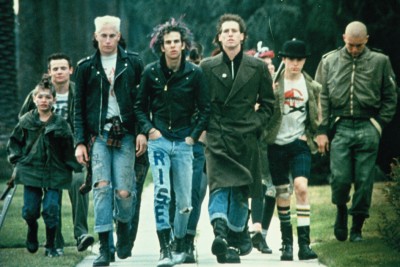
On DVD: Suburbia

With its roots planted firmly in the exploitation films of the 1970s, Penelope Spheeris' Suburbia is a gutsy, arresting movie that nevertheless can't escape the limitations of its small budget. Spheeris applied the exploitation formula to new subject matter, and a new setting, making Suburbia seem slightly more novel than it actually is. I would contend that Spheeris undercut her obvious passion for the plight of these characters by forcing them into a script filled with genre clichés.

After a wonderfully shocking opening sequence in which an infant is thrashed to death by a Doberman, we enter the world of the T.R. gang, a group of angry, dispossessed teenagers who - through one set of circumstances or another - have wound up homeless. They live in an abandoned neighborhood somewhere on the outskirts of Los Angeles, stealing food and branding each other with the initials of the gang (which stand for The Rejected). The T.R. kids find themselves hounded by psychotic middle-class home-owners and the police as they attempt to carve out a place for themselves in 1980s America.

First and foremost, these kids are pure punk. Characters like Jack Diddley and Joe Schmo sport ragged leather jackets adorned with their own embellishment and scrawled handwriting, outrageous hairstyles, and contempt for conventional wisdom in all its forms. The film's publicity materials make much of the fact that the movie contains "live" performances by D.I., The Vandals, and TSOL. The music is important, but what's more important is the "fuck you" attitude embodied by the characters in the movie, and their reasons for holding it. As an outgrowth of a decline in middle-class values - mainly the crumbling of the enormously attractive social façade first built in the 1950s and the fraudulent politics of the 1960s and 1970s - these characters represent a broad range of young people who came of age between 1975 and 1985. Self-mutilation, a lack of hygiene, music that expressed pure rage, and personal style that intended to offend were a few of their weapons. Writer-director Penelope Spheeris, who first covered the punk scene in her excellent documentary series, The Decline of Western Civilization, captures this attitude exceedingly well, and in that sense Suburbia is an interesting document of an era.

However, it doesn't have much else to recommend it. Spheeris chose to cast mostly non-actors, and that makes sense in theory, especially given her involvement in and knowledge of the LA punk scene. However, she may have taken this good idea too far; the actors don't appear to have been coached at all, delivering flat, perfunctory line readings. They often seem more like kids antsy to get the job done and go home than disaffected youth.

The film is inappropriately lit, sometimes looking more like an '80s sitcom than the gritty melodrama it means to be. And, while a film of this sort shouldn't look glossy and expensive, it should at least bear some level of editorial polish, but Suburbia is missing that element. It renders the storytelling choppy, arbitrary, and often inert.

Suburbia will be of interest to anyone with fond memories of the LA punk scene, early '80s movie culture, or exploitation flicks. It's too bad that it doesn't live up to its promise, however, as it could have easily been a much better film had more attention been paid to the performances and narrative filmcraft.

On DVD: Crazy Heart

Jeff Bridges owns Crazy Heart, and it's right that he should. This hugely charismatic actor has spent decades delivering riveting, often underrated work - from the teenage Duane Jackson in The Last Picture Show and the big-time sucker Terry Brogan in Against All Odds, to the idealistic automobile manufacturer in Tucker: The Man and His Dream and the indelible personification of the entire last half-century of Californian society and culture in The Big Lebowski. Bridges is an intuitive, committed actor whose remarkable range and enormous appeal have too often been taken for granted. Films like The Door in the FloorFearless, while mostly overlooked upon their initial release, demand both critical and popular reappraisal; both are outstanding films that owe a large part of their respective success to dynamic performances by Bridges. and

Finally, almost forty years after receiving his first nomination for 1971's The Last Picture Show, Bridges has his Oscar. But this is no consolation award of the Scent of a WomanCrazy Heart, and the film is nowhere near half bad, either. variety. Bridges is outstanding in

Bridges plays Bad Blake, a 57-year-old country music singer-songwriter. Blake tours desolate sections of the southwest, playing bowling alleys and saloons. Dissatisfied with the direction his life has taken, Blake spends most days wafting in and out of a drunken haze, barely appreciative of the many committed fans who consider him a legend. In Santa Fe, Blake agrees to an interview with a local newspaper reporter named Jean (Maggie Gyllenhaal). Jean is a lost soul, in a way, too, and she and Blake connect almost immediately. While struggling to build a relationship with Jean from the road, Blake contends with the success of his protégée Tommy Sweet (Colin Farrell), who is now a country superstar playing arenas and traveling with a fleet of tour buses. Sweet wants to help Blake through this low point in his career, but Blake is resistant to such "charity." Eventually, Blake agrees to write songs for Sweet - a sure source of income. Blake's relationship with Jean develops happily, but his drinking becomes an issue - particularly as it concerns his growing presence around her four-year-old son, Buddy. Although Blake confronts his alcoholism, not everything turns out as he had hoped.

Bridges' Bad Blake is a wonderful character, simultaneously flawed, self-hating, and likable. He has a good heart, but is afraid to use it. We know from the outset, even before we hear of Blake's background, that he has seen his share of heartache and personal disaster. Like a lot of great country songs, the script follows Blake in an arc that extends from the gutter to paradise, and back again (well, not quite). Bridges carries the entire film, appearing in every scene, dragging his raggedy bloated carcass around like dead weight. Bridges has always been a physical actor, and his body is on display here in a way that illustrates the sense of careless disregard Blake has for his own well-being. He slouches around, sweaty and unkempt in stained clothing, with his gut hanging out, unashamed, exhausted, and often drunk.

Although the story is not particularly fresh, there is something about the film that is. First-time writer-director Scott Cooper has crafted a tight script that maintains a strict focus on Blake, which in turn allows Bridges to hone a full, rounded performance. Building from that script and working with cinematographer Barry Markowitz, Cooper has shot a visually-cohesive picture that utilizes minimal, elegant camera setups and eschews unnecessary cutting. The visuals constantly remind us that this movie is purely about character and setting. It's an effective, focused approach that gives the actors a lot of freedom while avoiding narrative and visual distraction. Despite a handful of conceptual clichés, Crazy Heart is a well-crafted, immensely enjoyable film. 

Read the full review here