4.23.2010

On DVD: Ride With the Devil (Criterion Collection)

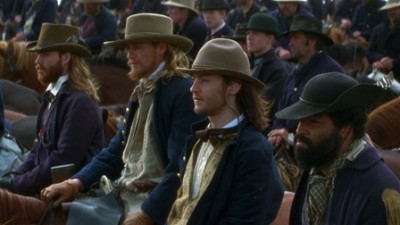
It's easy to understand why Ang Lee's 1999 film Ride With the Devil flew under the radar, almost completely unnoticed, during its original brief theatrical release. It is an unusual film, one in which good and evil are intertwined in an uncomfortably gray braid of striated allegiances. Delicately shaded performances (particularly by Jeffrey Wright) ground the propulsive, suspenseful narrative amid a brutal but realistic world.

German-born Jacob Roedel (Tobey Maguire) is a Missouri youth shocked into defense of the South when his neighbor Jack Bull Chiles' (Skeet Ulrich) farm is burned and father killed by a band of jayhawkers - militant irregular pro-Union guerrillas. Jake and Jack Bull join a band of bushwhackers - the pro-Confederacy counterparts to the jayhawkers. They join in league with George Clyde (Simon Baker) and Clyde's best friend, a freed slave named Holt (Jeffrey Wright). After a series of raids under the command of Black John Ambrose (James Caviezel), the smaller group retreats to a rural dugout to wait out the winter.

There, Jack Bull romances their local sponsor's widowed daughter-in-law, Sue Lee (Jewel Kilcher). But the relationship is short-lived; after Jack Bull dies, Roedel and Holt team up again with Ambrose's bushwhackers for increasingly vicious attacks. After a murderous raid at Lawrence, Kansas, Roedel and Holt are both wounded, and from there they escape to a safe farm where Sue Lee has been living since Jack Bull's death. At the farm, Roedel and Holt recover from their wounds and make momentous decisions about the future direction of their lives.

No plot summary, however, can do justice to the film's finely-woven themes. German-born Roedel and former slave Holt come to understand each other thanks to similar experiences with prejudice - and, even more importantly, their muddled sense of identity. Roedel's family, as German immigrants, are fully aligned with the Union - yet Roedel himself becomes a bushwhacker out of loyalty to Jack Bull and because he has considered himself, naturally, a Missourian. Later, he learns that his father has been murdered by another band of bushwhackers, throwing his already precarious sense of identity and political position into chaos.

Holt, meanwhile, is a former slave, who nevertheless finds himself fighting on the side of the Confederacy, like Roedel, due to personal loyalty to a friend. Holt has no illusions about the contradiction inherent in what he is doing; it's his own morality that drives him to stand by Clyde. But after Clyde dies, Holt knows, for the first time, what real freedom feels like.

The intertwined stories of Roedel and Holt elegantly transcend issues of race, just as the characters themselves grow to understand that there are vastly more fundamental questions of the human condition than the color of one's skin. At the same time, the film hardly pretends that race isn't a key issue in American life - the struggles of the past are explicitly related to problems that still exist in our country. All of this is expressed by screenwriter James Schamus and director Ang Lee with a far finer sensibility than I am able to convey through words alone here. Such deep conveyance of a complex and insidious social issue is rare in film. It's not just the way Ride With the Devil "addresses" race; it's the way the story portrays the deeper consequences of racial division upon individual human beings.

Ride With the Devil received a lot of flack for its casting, but I can't find any fault with it. Tobey Maguire has a tendency to come off as "soft," but I think he does a fine job here. He is a good actor who carries most of the picture without showing signs of strain. (Although I do take issue with the scenes of domestic comedy in the movie's final act - Maguire handling a baby in particular - I can't blame the actor.) As Sue Lee, Jewel is mostly credible; the only thing she has working against her is that she's recognizable as a music superstar. Otherwise, her performance is fine, if not spectacular.

As Holt, Jeffrey Wright steals the show. Holt is a difficult character, as written, but Wright brings a sense of moral clarity to Holt's words and actions. I'll even go as far as to say that, thanks to Wright, Holt may be one of the most complex, interesting, and significant characters from the last couple of decades of movies. 

Read the full review here

On DVD: Michelangelo: Self-Portrait

Like the best documentaries, Robert Snyder's Michelangelo: Self-Portrait is simultaneously entertaining, enriching, and inspiring. Simple in concept, but complex in its editorial approach, Snyder's film is narrated through the artist's own words, taken from diaries, letters, and early biographers, and accompanied by images of his work. The result is a stirring and unique film biography, one that is devoid of narrative cheats and artifice.

We begin with Michelangelo's voice in a letter to the great biographer Giorgio Vasari; the artist complains of his various ailments and describes a new pietà he has begun (the Rondanini Pietà). From here, the narration consists of more or less chronological biographical information in "flashback" form, as Michelangelo regales us with tales from his early life, his first works, and his imbroglios with authority - particularly the painting of the Sistine Chapel. Michelangelo: Self-Portrait is grounded in the artist's own time and own words; we see him as an artist and a man, assessing his own work with honest criticism and equally fair egotism. He is not a monolithic cultural figure here - he's a man driven to make art, in his own way, and often at great personal risk. Immune to criticism now, that was hardly the case during his lifetime.

The most compelling aspect of this documentary is not the biographical detail, per se, nor the beautifully photographed works of art on display here; the most revealing content comes from Michelangelo's discussion of the sense of investment he had in his art - the passion he felt, as well as the highly personal details present in almost every work he made. In a post-Impressionist world, it's too easy for modern audiences to shrug off Renaissance artists as hired guns, working for the authority figures of the era, whether they were Church officials or the nobility. We are quick to allow for supreme technical proficiency, but just as quick to ignore the soul of their work. The more overtly expressive art of the last century is easier to attribute (or impose) emotional significance. Here, Snyder gets at Michelangelo's own assessment of his work, as well as the intense connection he felt to it. In particular, the physicality of sculpture seems to have engendered a stronger bond between artist and material than with frescos and other painting. Michelangelo speaks of growing up around quarries and the intimacy with which he understood the manipulation of stone. Just as the artist's mind is often ignored, the craft of art-making is undervalued today; we tend to place a higher value on "expression," even though it's wholly subjective and impossible to measure.

This is a carefully-constructed film, and an enormous amount of time was spent shaping the script and selecting the imagery. Snyder's camera is patient and loving when photographing the Michelangelo's work, and his approach to editing is fluid and informative, always cutting or dissolving to images that dovetail appropriately with the narration. The narrator, interestingly, is not credited; I would assume it's Snyder himself. Music is almost contemporaneous (Monteverdi and Frescobaldi), and quotations from Dante are judiciously included.

Snyder's film is a great work of art itself: a documentary that reveals a man whose life and mind have been clouded by the vast scope of his artistic achievement. But ultimately, he was someone with his own share of triumphs and tragedies, very much a human being, and Snyder finds a way to access Michelangelo's humanity from across the centuries, in spite of his legendary status. 

On DVD: Six Centuries of Verse

It seems like every so often someone raises an alarm that poetry is facing extinction or, at best, irrelevancy. It's an understandable concern. Not many people read poetry outside the classroom, and those who do suffer from the stigma of being intelligent. It's true that in the last half-century poetry has suffered from the kind of flighty "anyone can be an artist" attitude that flourished in the wake of the 1960s. Form became unfashionable and rhyme is still viewed with some suspicion, backed by a fear among poets of appearing trivial. Only a deeply willful and egregiously blinkered culture such as ours would toss the poetry of Thomas Hardy onto the great bonfire of unread literature. Currently, however, there are major poets working hard to re-establish the value of formal limitations in poetry, as well as the kind of readability of which the greatest poets of their respective eras were acutely aware.

In another fantastic release from Athena (see Ancient Lives and The Christians for others), this sweeping overview of 600 years of English poetry enlivens the written word - an achievement exceedingly rare on television. Originally broadcast on Britain's ITV in 1984, and presented by the late, great Sir John Gielgud across sixteen half-hour episodes, Six Centuries of Verse covers poets great and small in all genres. From the great Old English epic Beowulf to the work of modernist masters Yeats and Auden, host Gielgud provides contextual narration interspersed with readings of significant poems by a stable of actors that includes Julian Glover, Lee Remick, Ralph Richardson, and Anthony Hopkins. Far from being dry or perfunctory, these readings are impassioned, fully-realized performances, invested with all manner of drama and attitude.

Gielgud's wonderful voice, austere manner, and driest of English wits make him a charming and affable host. He guides us with smooth confidence through various developments in language, form, topical subject matter, and genre. The integration of Gielgud's narration with the readings makes for a languid yet engaging presentation. The half-hour format allows us to absorb each topic without packing our brains too full, or over-indulging to the point where the poems become indistinguishable from each other. Assisting in the latter matter are the readers themselves, who are shot in different locations selected to complement the poem being read. Occasionally, works written in multiple voices are semi-dramatized, as with "The Parson's Tale" from Chaucer's The Canterbury Tales, or several selections by Shakespeare in the episode devoted to The Immortal Bard. (My favorite image from that episode, by the way, is without a doubt that of Gielgud and Ralph Richardson leaning over the top of a tall hedge, performing dialogue from Antony and Cleopatra.)

Episode titles are mostly self-explanatory:

Episode 1: "Chaucer - Ted Hughes, 1384-1984"
Episode 2: "Old English" (includes a discussion of Beowulf)
Episode 3: "Chaucer, 1340-1400"
Episode 4: "Medieval - Elizabethan, 1400-1600" (includes Thomas Wyatt, Marlowe, and Raleigh)
Episode 5: "Shakespeare, 1564-1616"
Episode 6: "Metaphysical & Devotional, 1590-1670" (includes Donne, Herbert, and Marvell)
Episode 7: "Milton, 1608-1674"
Episode 8: "Restoration & Augustan, 1660-1745" (includes Dryden, Swift, and Pope)
Episode 9: "Romantic Pioneers, 1750-1805" (includes Blake, Coleridge, and Wordsworth)
Episode 10: "Wordsworth, 1770-1850"
Episode 11: "Younger Romantics, 1800-1824" (includes Shelley, Keats, and Byron)
Episode 12: "Victorians, 1837-1901" (includes Tennyson, Bronte, Browning, and Arnold)
Episode 13: "American Pioneers, 1855-1910" (includes Whitman, Poe, and Dickinson)
Episode 14: "Romantics & Realists, 1870-1920" (includes Hardy, Hopkins, and Kipling)
Episode 15: "Early Twentieth Century, 1914-1939" (includes Yeats, Frost, Eliot, and Auden)
Episode 16: "Towards the Present, 1934-1984" (includes Dylan Thomas, Philip Larkin, and Auden) 

Read the full review here

On DVD: Summer Hours (Criterion Collection)

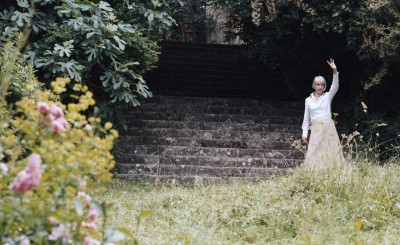
Olivier Assayas's Summer Hours (L'Heure d'ete) is a patient, beautifully-made film about a family dealing with a major, bittersweet transition. The influence of Eric Rohmer (another director who loved the summer) is unmistakable, but Summer Hours is very much its own film, one that looks at personal and familial legacies and how they are maintained - or not - by successive generations. Free of cinematic contrivance, this elegant movie challenges us gently, but firmly, to examine the proportions in which we value the past, present, and future.

The long opening sequence takes place at the rural family home of the Marlys, where they are celebrating the 75th birthday of their matriarch, Hélène (Edith Scob). Hélène is joined by her three children, Frédéric (Charles Berling), Adrienne (Juliette Binoche), and Jérémie (Jérémie Renier), and their families. Hélène's work for the past several decades has been the preservation of her uncle's legacy; Paul Berthier was a major painter and she has served as executor of his estate, guardian of his papers, and promoter of his work. At the party, Hélène takes Frederic, the only one of her three children who still lives in France, on a guided tour of her final wishes as to the disposition of her belongings, which include two paintings by Corot, several pieces of rare furniture, decorative panels by Odilon Redon, and fine glassware. Frederic, of course, doesn't wish to entertain thoughts of his mother's demise.

But, when Hélène dies several months later, the three children gather again to decide what to do with the house and manage the rest of her estate. Representatives of the Musée d'Orsay in Paris wind up taking a large portion of Hélène's belongings into the museum's permanent collection, and the house is prepared for sale, much to Frédéric's chagrin.

Summer Hours is an immensely pleasant film to watch. Assayas has assembled a fine cast, all of whom work together as a credible family unit. The three Marly siblings actually feel related, unlike other "family" films, where a collection of A-list actors can easily come off as a contrived concentration of ego instead of a group of blood relations. The photography is both skillful from a narrative point of view, as well as beautiful to look at. The house is shot so lovingly that by the end of the picture we feel as though we have lived there ourselves.

Thematically, Summer Hours doesn't offer easy answers. For instance, what are we to make, exactly, of the passing of Hélène's belongings to the Musée d'Orsay? The museum was directly involved in this film's production, and certainly they have an interest in portraying the d'Orsay as the guardian of fine things and protector of legacies. Yet there is an interesting ambivalence in Summer Hours as to the value of that. The objects that wind up in the d'Orsay - a rare desk, a rarer cupboard, and others - are displayed to a largely indifferent audience who pass them by without a glace. A museum, then, no matter how much it reveres its own collection, can't replace successive generations of family, who enthusiastically pass on stories of a piece's provenance, history, and its connections to various people and places.

At the same time, it's demonstrable that the Marlys don't care enough to hold on to these works - or the house they came from, which was once the residence of their great-uncle, an influential painter. The Marly siblings, living continents apart, are complicit in the disintegration of their own extended family; they make conscious choices to remain untroubled by the past, abandoning their shared heritage to an institution.

The film's final sequence takes us back to Hélène's country home, where we see Frédéric's eldest daughter staging a final, massive party before the sale closes. It's a real rager, with dozens of teenagers arriving by car and motorcycle, carrying booze and junk food. With loud pop music blaring, it seems like the place is going to combust with debauchery. But Hélène's granddaughter, who planned it all, escapes the crowd with a boy, taking him on a sentimental tour of the property. This suggestion of a generational shift in values - from embracing heritage to disposing of it, and back again - ends the film on a perceptive, hopeful note.

Read the full review here

On DVD: Possible Films, Volume 2: New Short Films by Hal Hartley

Hal Hartley was, in a fairly quiet way, one of the defining filmmakers of the 1990s. His spare, mannered, witty style presaged the work of Wes Anderson and Noah Baumbach, and his influence is even visible, to an extent, in Quentin Tarantino's films. The verbose, often opaque dialogue of his strange, still, oddly focused characters suggested the particular angst of that decade - a moody inward paranoia about the location of the border that divides sincerity from irony. Two of his best films - Simple Men (1992) and Henry Fool(1997, and a Cannes winner for Best Screenplay) - deal with this theme in diverse and extremely funny ways. Henry Fool can be read as one of the central cinematic statements of the 1990s, a film that delves deep into the tenor of the era, through characters who grapple with varied, shifting permutations of authenticity.

Hartley has directed four features in the twelve years since Henry Fool - none of which have received much attention from any sector of the film-going population. His most recent, Fay Grim (2007), was a sequel to Henry Fool, and was released by Magnolia Films simultaneously in (a few) theaters and on DVD. The film was not only deeply uninteresting, it almost leeched power away from its immensely superior predecessor.

I'm not surprised that Hartley seems to be moving away from films - or at least, away from theatrical features. His work in the 1990s was so of the 1990s - and how does an artist so engaged with a decade deal with an evolving culture? So, he has moved around Europe a lot lately, doing theatrical work and short films.

It comes as a great sadness to report that the five shorts in Possible Films, Volume 2 - all of which were made in the last five years - are like soggy crumbs fallen from the plate of a master. These lifeless experiments in form and style breathe none of the wit or mystery of the work Hartley is known for; the very real enthusiasm for filmmaking one feels when watching his best features is totally absent. Hartley wields the camera here with desultory disinterest, capturing these indulgent shorts as if he's being forced to do so against his will. There's no heart in any of them.

A/Muse (2009, 11:00) is about a young German actress determined to be cast by a well-known director (implicitly Hartley) in his next feature. She writes to him and seeks him out at the theater where he is directing a play, but these connections are missed. She finally receives a letter in which the director explains that he has left Germany for New York, where he intends to start a new business selling a brand of European window. Coy without being charming, A/Muse is the perfect introduction to this set of five transparently self-absorbed films.

Implied Harmonies (2008, 28:05) is the most engaging of the five. It is a documentary about the production of an opera called La Commedia, composed by Louis Andriessen and directed by Hartley. (It was staged in Amsterdam.) This strange film, however, does not tell you a whole lot about the opera in concept or content. The film is too impressionistic to convey information, even though it's about a real project that actually took place. Still, there is something interesting here about the collaboration between Andriessen and Hartley, even though it's inadequately presented.

The Apologies (2009, 13:36) is about an aspiring actress who house-sits for a writer friend, where she practices a monologue repeatedly. The friend's ex-girlfriend shows up to drop off a set of keys and recite a rather trite monologue of her own, thinking the writer is in the apartment somewhere, hiding from her.

Adventure (2008, 20:26) is a really strange, alarming, and oddly invasive autobiographical piece about Hartley's relationship with his wife, the Japanese actress Miho Nikaido. Despite the film's ostensible "intent," I learned nothing about love, marriage, or Nikaido from this film - what I did learn is that Hal Hartley is a much bigger egotist than I would have imagined. There are cutesy title cards that talk about Hartley and Nikaido in the third person, a lot of tiresome shots of trains and orchards, and ongoing inane chatter. There's something particularly upsetting about the moment when Hartley casually presents his wife's candidly naked breasts for all to see.

Accomplice (2009, 3:08) is an indescribable short that includes shots of Hartley's colleague Jordana Maurer at work and a voice-over by Jean-Luc Godard about how it's always "possible" to make films. Easy for Godard - and Hartley - to say.