9.29.2011

The Turtleneck and Jeff


Every time that other company made an announcement, Jeff waited in the wings, sweating, thinking, "It's my time now!" He was tired of waiting. He had his lines memorized. He had quality announcements, too!

But the man in the black turtleneck always showed up -- even when least expected. He always showed up and played his part, and played it well, in that turtleneck and blue jeans. His hair cropped just so, a hint of the hipster added a certain edge to the dork factor. He always showed up, leaving Jeff waiting -- again. The Turtleneck always trumped Jeff's best chances for success.

But one's man's tragedy is another man's opportunity. Wednesday, Jeff was center-stage. He chose his costume carefully, wary of comparisons. Comparisons would be made, he knew, so why not tweak their expectations? He wore black, but it was a jacket instead of a turtleneck. His head was shaved, but he was quite bald to begin with.

That other company had design in its corner. It had slick simplicity and good ideas that people responded to. But when The Turtleneck retired, Jeff knew what he had to do. Jeff's pot was always simmering -- things bubbled, but never quite frothed over, although it’s true that the Kindle was his iPod. But streaming video was an add-on, not a revenue stream. Jeff had ideas, but was unsure how to package them, where to position them, or when. He had a sense of where his business would go, with or without him, and he was going to make damn sure he was along for the ride -- just as The Turtleneck had done at his company. Jeff was going to seize this moment with the kind of bombshell he always knew he'd need to drop. The device, the software, the demand, the market, the momentum, and the timing -- he had it all right now, at this moment. It was his.

The Turtleneck was out of the picture. Jeff was free to be his own man again. Apart from a period as a new-kid media darling in the late 1990s and his periodic text-based announcements to customers, Jeff had remained quiet, partly because he knew that The Turtleneck was the tech world's key celebrity, and he did not want to compete. But things had changed.

On Wednesday, his costume designer and make-up man came in early, following an extended color and fabric consultation earlier in the week. Jeff had a protein shake that was hard to keep down, and stayed on the treadmill until his nausea had subsided. He repeated the phrase "Twenty dwarves took turns doing handstands on the carpet" to limber up his tongue and jaw muscles. A masseuse pummeled his shoulders for a good ten minutes and a voice coach helped him keep his Spanish accent a secret as an ancient voodoo priest anointed him with perfumed oils.

His time was now. He was no longer an understudy. The lights came up, and he walked out to greet the world anew.

7.06.2011

Michelle Amador's Heartland Tour (and Me)

I'm honored to be a part of this thing. 

Michelle Amador and her husband Tim Bulkley are friends of mine from way back. Now based in New York, Michelle has valiantly advanced her career in the non-profit arts world, while continuing to grow and gain recognition as a singer-songwriter. Her roots are in the jazz tradition, but her sound goes well beyond that. Tim is a drummer beyond compare - he has a jazz background as well.
 

Michelle Amador
This summer, Michelle is touring the nation with a grassroots angle. Each stop on her Heartland tour will entail some combination of exploration, communication with other creative people (artists and non-artists), and performance with local artists working in a variety of disciplines. The concept was developed by Erin Coppin, Michelle's close friend, and whose "Love is All Around" photo project provided a lot of the inspiration behind the tour (http://www.inheartlandia.com/). 

Erin and Michelle's goal is to foster an ongoing dialogue that bridges national regions, creative goals, and modes of expression. In Michelle's words, it's "a collaborative, cross-medium artist/non-artist search for what's at the center, for what's in our hearts - our own, and those we encounter."

Barbara Gray
Tim Bulkley
Goh Nakamura
I am excited to be participating (reading from my own work) in two of the Heartland events: one in Los Angeles on Sunday, July 17th, and one in San Jose, CA, on Tuesday, July 19th.  

In Los Angeles, we'll be joined by comedian Barbara Gray, and in San Jose we'll have singer/songwriter/actor Goh Nakamura with us.  At each event, Michelle will perform her own work and that of others with a small combo featuring Tim on drums.

The Heartland tour is being funded by a Kickstarter-style campaign, launched recently by Michelle and Erin, and which has already raised nearly half of the tour's budget. Admission to Heartland tour events is open to the public at the price of a very modest suggested donation to the tour. Donations to the Heartland campaign - which I strongly encourage! - can be made here:

 
http://theheartlandtour.bandzoogle.com

Info on the dates I'll be joining Heartland are below. For the full tour schedule, check the link above.


Heartland in Los Angeles
Michelle Amador and Tim Bulkley, with comedian Barbara Gray and readings by Casey Burchby
Location TBA
7:00 p.m.
$10.00 suggested donation

Heartland in San Jose
Michelle Amador and Tim Bulkley, with singer/songwriter Goh Nakamura and readings by Casey Burchby
The Ronco Home
1651 Campbell Avenue
7:00 p.m.
$10.00 suggested donation

6.30.2011

How Did You Do It? A Conversation with Rob Corddry

Rob Corddry’s newest series, Adult Swim’s Childrens Hospital (that’s right: no apostrophe), is a gag-a-second mockery of one of television’s old standbys: the medical drama. Childrens Hospital is the next logical step for Corddry, who began as an actor in college, continued into improv with the Upright Citizens Brigade, and landed a spot on The Daily Show in 2002. Since then, he’s made some memorable appearances in movies, including Hot Tub Time Machine, and a role as presidential press secretary Ari Fleischer in Oliver Stone’s W.

On Thursday, June 30th, SF Sketchfest will present the cast of Childrens Hospital live on stage, along with the cast of the forthcoming series National Terrorism Strike Force: San Diego: Sport Utility Vehicle [NTSF: SD: SUV] – a parody of police procedurals and action programs in the vein of 24. That show, which premieres next month on Adult Swim, was created by Paul Scheer, formerly a partner of Corddry’s at Upright Citizens Brigade, and co-stars Rob Riggle, who worked with Corddry both at UCB and The Daily Show.

I started my recent conversation with Corddry by asking him about the earliest part of his career.

What was your training prior to joining the Upright Citizens Brigade?

I was a theater and English major in college, and literally the day after graduation, I moved to New York City. I hit the pavement pretty hard and was set on becoming the highest-paid crappy Shakespearean actor ever. I would get Backstage magazine and audition for absolutely everything. And one of the things I got was a play where I met this woman who was in a sketch group. So I auditioned for the sketch group, and I got it. And I was like, “Do I really want to do this? I’m a very important Shakespearean actor.” But six months later, I was furiously writing sketches and learning how to do comedy. We were terrible. It was the worst sketch group in New York’s history. Then I started a sketch group with a bunch of friends called Naked Babies, which exists today – but then, we found UCB.

What years were you at the UCB in New York?

I was actively doing shows every night from about ’97 to about 2001, 2002. When I got on The Daily Show, I just didn’t have the time. And from then on, I’ve just performed sporadically. But for a few years, it was five to seven shows a week. Paul Scheer [Childrens Hospital guest star and creator of NTSF: SD: SUV] and Rob Huebel [co-star of Childrens Hospital] and Rob Riggle [fellow alum of The Daily Show and co-star of NTSF: SD: SUV] were in the class ahead of me.

Were you aware at the time that The Daily Show was going to be a leap forward for you? Looking back on it now, how do you think that experience affected your approach to comedy in general?

I was certainly aware of how special it was. It definitely seemed like a “right time, right place” scenario. We knew it was lightning in a bottle. I wasn’t really thinking about how much it was going to help my career – any more than I always do. [Laughs] My career has been a very long, slow, gradual turtle-walk up a long flight of stairs. But that’s good because that means there’s always an easy learning curve. But The Daily Show did teach me how to be funny on TV – which is how it informed my present work.

Has anyone in the press ever tried to pull a Daily Show-style interview on you?

There was one kid – I was in Austin for something, and somebody interviewed me on the street. Some college kids. And they kept hitting me in the mouth with the microphone. I was like, “Really? You’re pulling a Mo Rocca, circa the year 2000 on me?”

Given that you and most of the cast of Childrens Hospital have a background in improv, I wondered if improvisation played any part in the development of the show.

The development process was very deliberate. But there is improv happening once we feel like we’ve got what we need in the script. Of course, it would be a shame to waste the talents of these brilliant improvisers – I mean, Rob Huebel is probably one of the best improvisers alive. So, I can definitely point to a couple of lines in each episode that are improvised. But for the most part, it’s a tightly-scripted show. And we all have our strengths. Jon Stern, who will be at the show in San Francisco, is one of those rare producers who can write a great joke and can also book a caterer. David has way more experience with that than I do, too. I’m just the monkey in the corner spouting jokes and clanging cymbals.

Are you still the primary writer? You’re credited with many of the scripts.

I like to write about half of them. And I enjoy doing it. It’s really fun to write this show. But also, the three of us edit every script that comes in written by someone else – just to control the voice of the show.

I understand that when you brought the show from the web series to Adult Swim, you preferred the 15-minute format offered by Adult Swim as opposed to the standard 30-minute format of most comedy shows.

Absolutely. I had no interest in bringing it to television at all, until I heard that there was such a thing as a 15-minute format. I just don’t think this relentless joke-after-joke kind of show would be interesting after 15 minutes. This is joke-based comedy, as opposed to character- or relationship-based comedy.

The spinoff [NTSF: SD: SUV] begins airing next month?

As much as I’d like to take credit, it’s not a spinoff and I had nothing to do with it. Jon Stern is the connection – he’s executive producing it with my good friend Paul Scheer. And we come from the same family of comedy – I’d say it’s the same genre. But there’s no real connection to Childrens.

But it [NTSF: SD: SUV] began as a phony advertisement during the re-broadcast of the initial web version of Childrens Hospital on Adult Swim.

That’s right. Paul was nice enough to bail me out, in a way, because I was about 45 seconds to a minute short for one episode. They had shot that fake commercial as sort of a pilot, so Jon suggested sticking that in there. I said, “Great! As long as there’s a lot of punching.”

Will the San Francisco show mark the first time the Childrens Hospital cast has performed live together?
 
Last season we did some screenings, where we did some live bits – some successful, some not. We’ve learned our lesson and we’ve planned this show out a little bit more. We’re each going to show an episode that hasn’t been seen yet, and we’ll do a Q&A together. And we’ll do some bits. Actually, we’re slowly plotting a live Childrens Hospital tour. We wanted to get it out this fall, but that’s not going to happen. So ideally, we’d like to do it in the spring, before colleges let out. It’s a beast to put together, and none of us have a lot of time. This would be a tightly-scripted show. There would be live music – actually, I believe it’s going to be a musical.

This article is an expanded version of a piece that originally ran on the SF Weekly's arts blog, Exhibitionist. The original version is available here.

6.21.2011

On DVD: The Company Men


A topical film that grapples (somewhat aloofly) with the importance of "work" in our daily lives, The Company Men is reasonably intelligent and well-acted - and it features Kevin Costner finally pulling off an accent. Writer-director John Wells tackles the ongoing recession with sensitivity, portraying three characters (played by Ben Affleck, Tommy Lee Jones, and Chris Cooper) whose positions within a single large corporation are affected in differing ways by the company's need to continue providing good quarterly results to investors amid an ongoing economic crisis. Yet Wells doesn't quite go far enough; these three characters' identities are very much bound up in their jobs, and Wells never properly examines the consequences of self-identifying as a salesman, an executive, or a middle manager in a changing world that challenges our own ethical and moral standards.

Affleck plays Bobby Walker, a successful sales executive at a large ship-building corporation headed by Jim Salinger (Craig T. Nelson) and Gene McClary (Tommy Lee Jones). Unexpectedly finding himself the victim of down-sizing, Walker has trouble adjusting to unemployment. He doesn't want to give up his Porsche or his country club membership, stubbornly believing their symbolic value will help get him a new job. His pragmatic wife (Rosemarie Dewitt) insists that he find a job - any job - to help keep their family afloat. So Walker goes to work in construction for his brother-in-law, Jack (Kevin Costner), essentially learning a new trade from scratch. Meanwhile, his former company continues to fall apart, with company co-founder McClary and the depressive manager played by Cooper also losing their jobs.

Wells elicits fine performances from his outstanding cast, who have numerous Oscars among them. Jones is particularly fine, his face a road map of heartache and hard living that lends a somber self-awareness to McClary, who knows only too well that many have suffered at his expense over his years of hard work and empire-building. Nelson is beefy and dickish as a cold pragmatist who will do whatever it takes to keep his company in the black. And Costner strikes the right note as a blue-collar professional who wryly enjoys the satisfaction of an honest day's work.


The film's plot is a straightforward look at a loss of pride and the ensuing struggle for redemption, placed in a contemporary, realistic milieu. When Walker and several former co-workers gather at a placement agency as they seek employment, the sense of shame that attends a loss of status and income is palpable. Yet the Affleck character's struggle is diminished when we see him driving a Porsche, living in a house that's got to be 3,000 square feet, and playing golf as he sees fit. This could have been treated as a poignant reminder that many of our larger economic problems can be attributed to massive consumption and ignorance on an individual basis, but these scenes are not handled that way. Walker is simply a prideful man who doesn't want to be stripped of his toys.


And this brings me to what troubles me about
The Company Men, which, as I suggested, is competently made and well-acted. Yet there's a nagging hollowness within the movie's real, tangible themes. Wells does not search hard enough for the significance of work in people's lives. Other than "having a job" as a source of pride and income, there is not much in the movie that talks substantively as to what that work really accomplishes beyond its immediate benefit to the employed. In other words, the questions I would have liked to see asked include: Why do we work at the jobs we have? Why do we have those jobs in the first place? These and related questions are exactly the ones that the newly-unemployed have the opportunity to ask and the present recession has indeed led many to shift their career tracks entirely.

The conclusion of
The Company Men sees Affleck throwing in with the Jones character as they launch a brand-new enterprise together, in an attempt at empire-building all over again. The final scenes are hasty, and I have to assume they were tacked on at the last minute. This assumption is bolstered by an "alternate ending" included on the DVD as a special feature. This alternate ending doesn't add different footage, it just draws the film to a more organic close at an earlier and more appropriate point. In short, Affleck stays on with Costner's character, having decided to make a go of it in the construction business. This ending at least gets within shouting distance of the issues I would have like to see raised in the film, with Affleck re-assessing his career and the kind of people he wants to work with. But the ending we have skirts all of that, making the point that only a legitimate corporate career can provide Affleck with fulfillment - a depressing prospect, to be sure, and a low note upon which to conclude the film. 

Read the full review here

6.18.2011

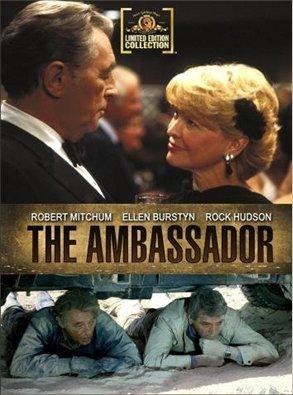
On DVD: The Ambassador (MGM Limited Edition Collection)

The Ambassador is a lot of ridiculous fun with a bizarre combination of elements, including a very 1980s thriller milieu involving middle eastern political strife and terrorism, a 1930s pulp adventure plot, and two major stars of yesteryear - Robert Mitchum and Rock Hudson (his last film) - being directed by the capable and prolific J. Lee Thompson. Throw in good supporting performances by Oscar-winner Ellen Burstyn and former Blofeld Donald Pleasance, and you have an entertaining (and somewhat campy) action picture that's hiding a few interesting surprises.

The film opens with United States ambassador to Isreal Peter Hacker (Mitchum) and his security aide Frank Stevenson (Hudson) traveling out into the Judean desert to secretly meet with representatives of the PLO. The meeting is broken up when the group is attacked simultaneously by the Israeli secret service and members of a radical PLO splinter group; each of these groups first attacks the rendezvous and then each other. It's a chaotic batshit sequence that confuses the participants amid decent aerial camerawork and rapid-fire gunplay.

Meanwhile, Hacker's wife Alex (Burstyn) is involved in an affair with an antiquities merchant who turns out to have ties to the PLO. The same splinter group that attacked Hacker's desert meet with the PLO is tracking Alex's movements and films her illicit trysts, using the footage to blackmail Hacker into desisting from his attempts at diplomacy among the various interested parties. (I would be remiss if I did not at least mention the, uh, two surprises that Burstyn - aged 52 at the time of the film's production - provides in these early scenes.)

As far as the story goes, it's a pulpy mess of cliches and easy action-film tropes. But the cast keeps things interesting, especially the odd dynamic between Mitchum and Burstyn's characters. These middle-aged globe-trotting bureaucrats don't have much of a marriage, and when Burstyn's affair is revealed, Mitchum's response is more empathetic than angry. The situation ends up bringing them closer together. I don't know how realistic this scenario is, but the actors bring it off well, sharing a world-weary closeness that grows interestingly as the film goes on.

Other aspects of the film are muddled at best - particularly the conclusion, which features gathering of students from both sides of the Israeli-Palestinian conflict, who have convened at Hacker's behest to talk peacefully about a way forward. They wind up being massacred by the machine guns of the PLO splinter group in a violent sequence that eerily prefigures (at least in some respects) the 1987 Mecca massacre. It's a bloody scene that, like much of the film in general, doesn't accomplish much dramatically while maintaining the highest standard of sensationalism. Still, The Ambassador is weird, choppy fun that is maintained by a cast of legendary Hollywood stars.